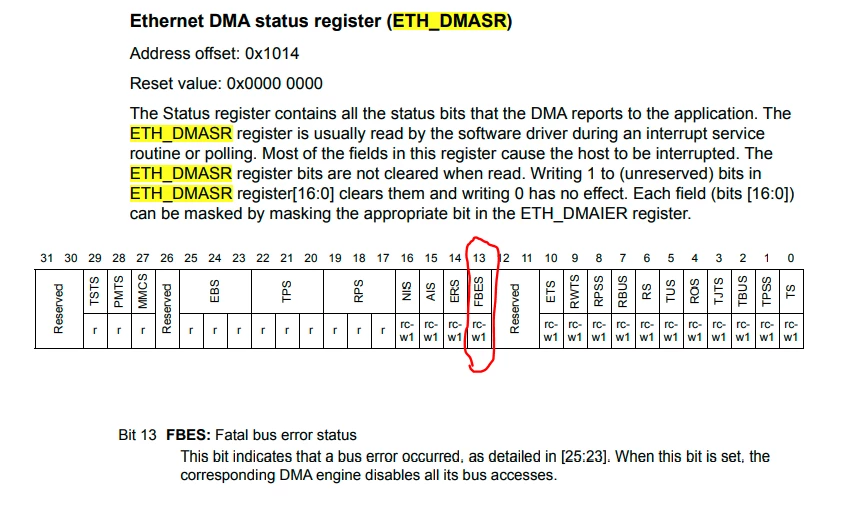
Question
Ethernet for ST32F407 gave me HAL_ETH_ERROR_DMA when I plugin the ethernet cable
I have an STM32F407 with the ethernet PHY DP83848.
I cannot ping the device if I'm using the LwIP because I'm facing some errors.
I belive that this can be an bug in STM32CubeIDE 1.9.0.
I do the following steps to reproduce the error.
- I start up my PCB board
- I let the initialization do its job and I get no error back.
- I plugin my ethernet cable
- I ping a random device with a random number
Then my activity LED blink on the DP83848 and then I get an interrupt.
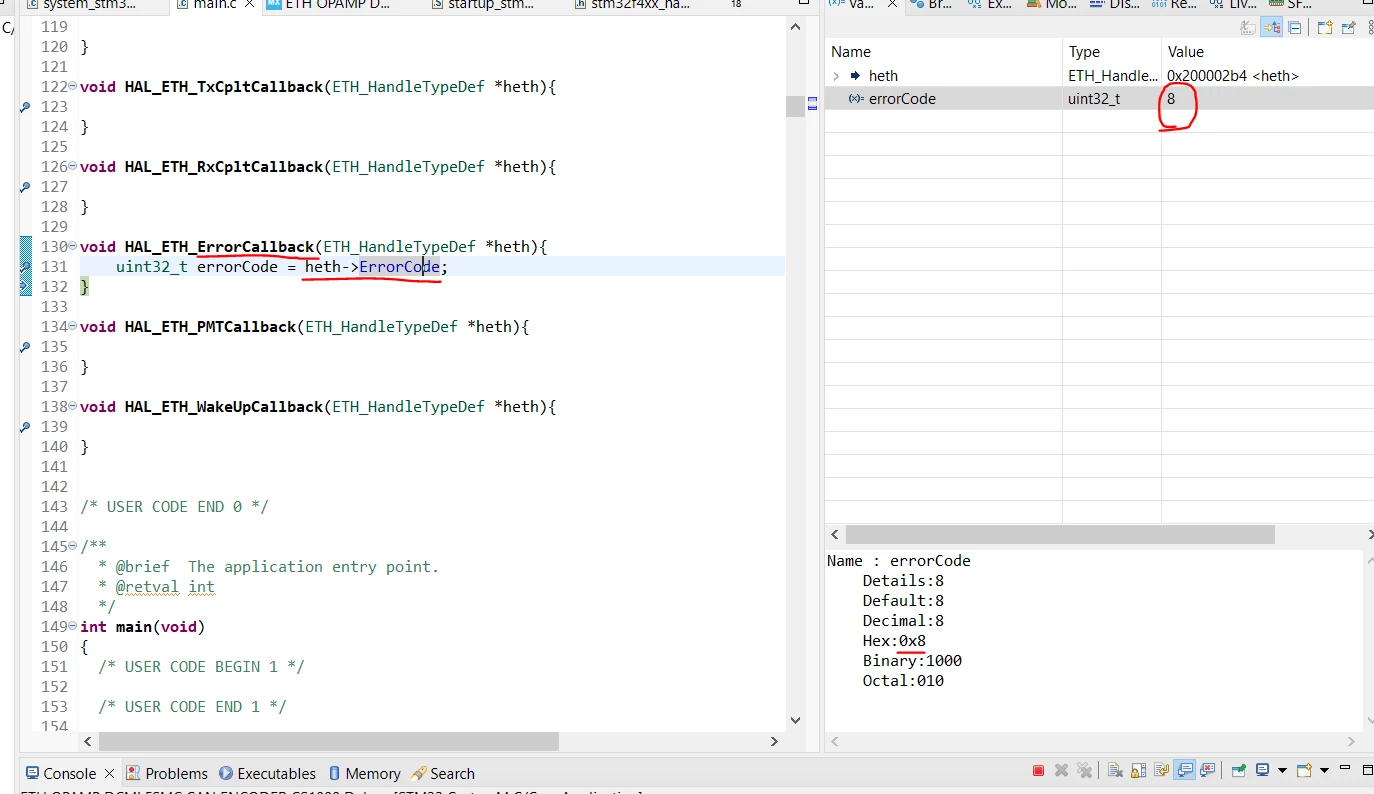
I get the error code 0x8. That means I'm facing DMA issues. But why?
/** @defgroup ETH_Error_Code ETH Error Code
 * @{
 */
#define HAL_ETH_ERROR_NONE ((uint32_t)0x00000000U) /*!< No error */
#define HAL_ETH_ERROR_PARAM ((uint32_t)0x00000001U) /*!< Busy error */
#define HAL_ETH_ERROR_BUSY ((uint32_t)0x00000002U) /*!< Parameter error */
#define HAL_ETH_ERROR_TIMEOUT ((uint32_t)0x00000004U) /*!< Timeout error */
#define HAL_ETH_ERROR_DMA ((uint32_t)0x00000008U) /*!< DMA transfer error */
#define HAL_ETH_ERROR_MAC ((uint32_t)0x00000010U) /*!< MAC transfer error */
#if (USE_HAL_ETH_REGISTER_CALLBACKS == 1)
#define HAL_ETH_ERROR_INVALID_CALLBACK ((uint32_t)0x00000020U) /*!< Invalid Callback error */
#endif /* USE_HAL_ETH_REGISTER_CALLBACKS */
/**
 * @}
 */
My STM32F407 does not have DMA for Ethernet. What should I do now? Is this a bug?
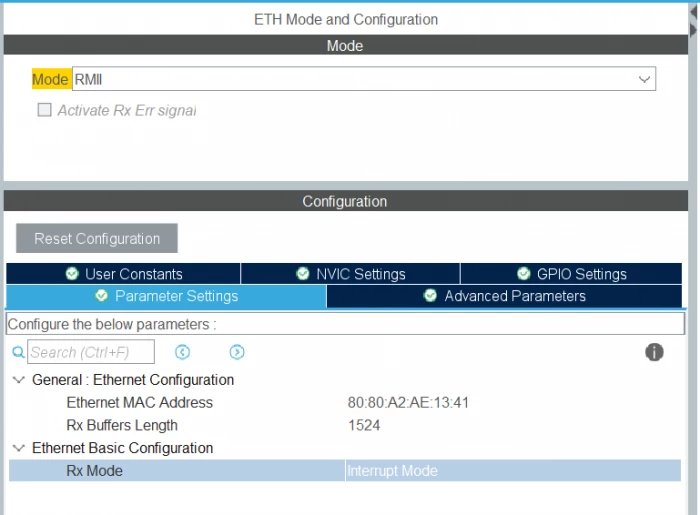
My complete code:
ETH_TxPacketConfig TxConfig;
ETH_DMADescTypeDef DMARxDscrTab[ETH_RX_DESC_CNT]; /* Ethernet Rx DMA Descriptors */
ETH_DMADescTypeDef DMATxDscrTab[ETH_TX_DESC_CNT]; /* Ethernet Tx DMA Descriptors */

 ADC_HandleTypeDef hadc1;

CAN_HandleTypeDef hcan1;

DCMI_HandleTypeDef hdcmi;
DMA_HandleTypeDef hdma_dcmi;

ETH_HandleTypeDef heth;

RTC_HandleTypeDef hrtc;

SPI_HandleTypeDef hspi2;

TIM_HandleTypeDef htim1;
TIM_HandleTypeDef htim3;
TIM_HandleTypeDef htim4;

UART_HandleTypeDef huart5;

SRAM_HandleTypeDef hsram1;

/* USER CODE BEGIN PV */

/* USER CODE END PV */

/* Private function prototypes -----------------------------------------------*/
void SystemClock_Config(void);
static void MX_GPIO_Init(void);
static void MX_FSMC_Init(void);
static void MX_DCMI_Init(void);
static void MX_SPI2_Init(void);
static void MX_TIM1_Init(void);
static void MX_TIM3_Init(void);
static void MX_ADC1_Init(void);
static void MX_CAN1_Init(void);
static void MX_RTC_Init(void);
static void MX_TIM4_Init(void);
static void MX_DMA_Init(void);
static void MX_UART5_Init(void);
static void MX_ETH_Init(void);
/* USER CODE BEGIN PFP */

/* USER CODE END PFP */

/* Private user code ---------------------------------------------------------*/
/* USER CODE BEGIN 0 */

void HAL_ETH_ErrorCallback(ETH_HandleTypeDef *heth){
	uint32_t errorCode = heth->ErrorCode;
}


/* USER CODE END 0 */

/**
 * @brief The application entry point.
 * @retval int
 */
int main(void)
{
 /* USER CODE BEGIN 1 */

 /* USER CODE END 1 */

 /* MCU Configuration--------------------------------------------------------*/

 /* Reset of all peripherals, Initializes the Flash interface and the Systick. */
 HAL_Init();

 /* USER CODE BEGIN Init */

 /* USER CODE END Init */

 /* Configure the system clock */
 SystemClock_Config();

 /* USER CODE BEGIN SysInit */

 /* USER CODE END SysInit */

 /* Initialize all configured peripherals */
 MX_GPIO_Init();
 MX_FSMC_Init();
 MX_DCMI_Init();
 MX_SPI2_Init();
 MX_TIM1_Init();
 MX_TIM3_Init();
 MX_ADC1_Init();
 MX_CAN1_Init();
 MX_RTC_Init();
 MX_TIM4_Init();
 MX_DMA_Init();
 MX_UART5_Init();
 MX_ETH_Init();
 /* USER CODE BEGIN 2 */

 /* Start up LCD */
 HAL_GPIO_WritePin(LCD_RESET_GPIO_Port, LCD_RESET_Pin, GPIO_PIN_SET);
 LCD_BL_ON();
 lcdInit();

 HAL_GPIO_WritePin(ETH_RESET_GPIO_Port, ETH_RESET_Pin, GPIO_PIN_RESET);
 HAL_Delay(1);
 HAL_GPIO_WritePin(ETH_RESET_GPIO_Port, ETH_RESET_Pin, GPIO_PIN_SET);

 /* Enable interrupt */
 HAL_ETH_Start_IT(&heth);


 /* USER CODE END 2 */

 /* Infinite loop */
 /* USER CODE BEGIN WHILE */
 while (1)
 {
 /* USER CODE END WHILE */

 /* USER CODE BEGIN 3 */

 }
 /* USER CODE END 3 */
}


/**
 * @brief DCMI Initialization Function
 * @param None
 * @retval None
 */
static void MX_DCMI_Init(void)
{

 /* USER CODE BEGIN DCMI_Init 0 */

 /* USER CODE END DCMI_Init 0 */

 /* USER CODE BEGIN DCMI_Init 1 */

 /* USER CODE END DCMI_Init 1 */
 hdcmi.Instance = DCMI;
 hdcmi.Init.SynchroMode = DCMI_SYNCHRO_HARDWARE;
 hdcmi.Init.PCKPolarity = DCMI_PCKPOLARITY_RISING;
 hdcmi.Init.VSPolarity = DCMI_VSPOLARITY_HIGH;
 hdcmi.Init.HSPolarity = DCMI_HSPOLARITY_LOW;
 hdcmi.Init.CaptureRate = DCMI_CR_ALL_FRAME;
 hdcmi.Init.ExtendedDataMode = DCMI_EXTEND_DATA_8B;
 hdcmi.Init.JPEGMode = DCMI_JPEG_DISABLE;
 if (HAL_DCMI_Init(&hdcmi) != HAL_OK)
 {
 Error_Handler();
 }
 /* USER CODE BEGIN DCMI_Init 2 */

 /* USER CODE END DCMI_Init 2 */

}

/**
 * @brief ETH Initialization Function
 * @param None
 * @retval None
 */
static void MX_ETH_Init(void)
{

 /* USER CODE BEGIN ETH_Init 0 */

 /* USER CODE END ETH_Init 0 */

 static uint8_t MACAddr[6];

 /* USER CODE BEGIN ETH_Init 1 */

 /* USER CODE END ETH_Init 1 */
 heth.Instance = ETH;
 MACAddr[0] = 0x80;
 MACAddr[1] = 0x80;
 MACAddr[2] = 0xA2;
 MACAddr[3] = 0xAE;
 MACAddr[4] = 0x13;
 MACAddr[5] = 0x41;
 heth.Init.MACAddr = &MACAddr[0];
 heth.Init.MediaInterface = HAL_ETH_RMII_MODE;
 heth.Init.TxDesc = DMATxDscrTab;
 heth.Init.RxDesc = DMARxDscrTab;
 heth.Init.RxBuffLen = 1524;

 /* USER CODE BEGIN MACADDRESS */

 /* USER CODE END MACADDRESS */

 if (HAL_ETH_Init(&heth) != HAL_OK)
 {
 Error_Handler();
 }

 memset(&TxConfig, 0 , sizeof(ETH_TxPacketConfig));
 TxConfig.Attributes = ETH_TX_PACKETS_FEATURES_CSUM | ETH_TX_PACKETS_FEATURES_CRCPAD;
 TxConfig.ChecksumCtrl = ETH_CHECKSUM_IPHDR_PAYLOAD_INSERT_PHDR_CALC;
 TxConfig.CRCPadCtrl = ETH_CRC_PAD_INSERT;
 /* USER CODE BEGIN ETH_Init 2 */

 /* USER CODE END ETH_Init 2 */

}

/**
 * Enable DMA controller clock
 */
static void MX_DMA_Init(void)
{

 /* DMA controller clock enable */
 __HAL_RCC_DMA2_CLK_ENABLE();

 /* DMA interrupt init */
 /* DMA2_Stream1_IRQn interrupt configuration */
 HAL_NVIC_SetPriority(DMA2_Stream1_IRQn, 0, 0);
 HAL_NVIC_EnableIRQ(DMA2_Stream1_IRQn);

}

/* FSMC initialization function */
static void MX_FSMC_Init(void)
{

 /* USER CODE BEGIN FSMC_Init 0 */

 /* USER CODE END FSMC_Init 0 */

 FSMC_NORSRAM_TimingTypeDef Timing = {0};

 /* USER CODE BEGIN FSMC_Init 1 */

 /* USER CODE END FSMC_Init 1 */

 /** Perform the SRAM1 memory initialization sequence
 */
 hsram1.Instance = FSMC_NORSRAM_DEVICE;
 hsram1.Extended = FSMC_NORSRAM_EXTENDED_DEVICE;
 /* hsram1.Init */
 hsram1.Init.NSBank = FSMC_NORSRAM_BANK1;
 hsram1.Init.DataAddressMux = FSMC_DATA_ADDRESS_MUX_DISABLE;
 hsram1.Init.MemoryType = FSMC_MEMORY_TYPE_SRAM;
 hsram1.Init.MemoryDataWidth = FSMC_NORSRAM_MEM_BUS_WIDTH_16;
 hsram1.Init.BurstAccessMode = FSMC_BURST_ACCESS_MODE_DISABLE;
 hsram1.Init.WaitSignalPolarity = FSMC_WAIT_SIGNAL_POLARITY_LOW;
 hsram1.Init.WrapMode = FSMC_WRAP_MODE_DISABLE;
 hsram1.Init.WaitSignalActive = FSMC_WAIT_TIMING_BEFORE_WS;
 hsram1.Init.WriteOperation = FSMC_WRITE_OPERATION_ENABLE;
 hsram1.Init.WaitSignal = FSMC_WAIT_SIGNAL_DISABLE;
 hsram1.Init.ExtendedMode = FSMC_EXTENDED_MODE_DISABLE;
 hsram1.Init.AsynchronousWait = FSMC_ASYNCHRONOUS_WAIT_DISABLE;
 hsram1.Init.WriteBurst = FSMC_WRITE_BURST_DISABLE;
 hsram1.Init.PageSize = FSMC_PAGE_SIZE_NONE;
 /* Timing */
 Timing.AddressSetupTime = 10;
 Timing.AddressHoldTime = 15;
 Timing.DataSetupTime = 20;
 Timing.BusTurnAroundDuration = 0;
 Timing.CLKDivision = 16;
 Timing.DataLatency = 17;
 Timing.AccessMode = FSMC_ACCESS_MODE_A;
 /* ExtTiming */

 if (HAL_SRAM_Init(&hsram1, &Timing, NULL) != HAL_OK)
 {
 Error_Handler( );
 }

 /* USER CODE BEGIN FSMC_Init 2 */

 /* USER CODE END FSMC_Init 2 */
}
Update:
Here is more information. I found a DMA error code.
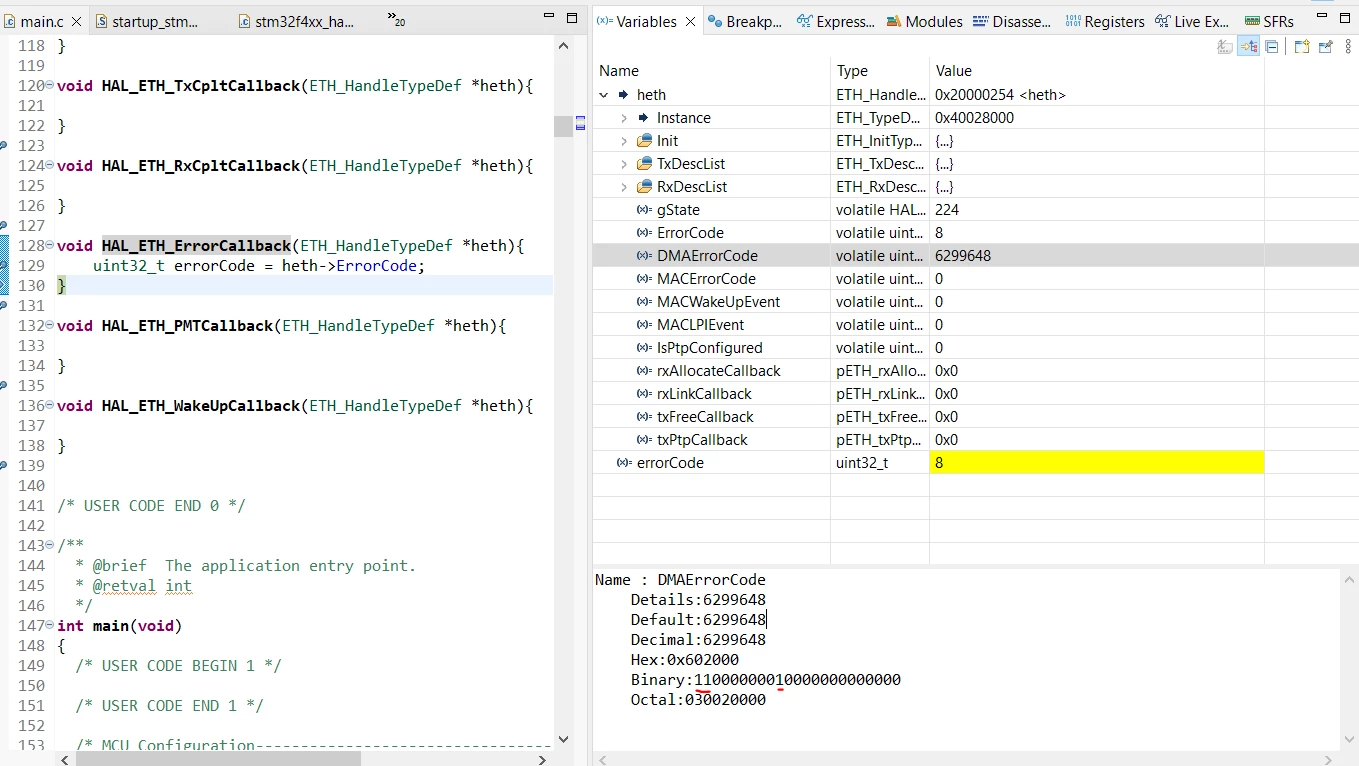 Here comes the error code from. See arrow.
/* ETH DMA Error */
 if (__HAL_ETH_DMA_GET_IT(heth, ETH_DMASR_AIS))
 {
 if (__HAL_ETH_DMA_GET_IT_SOURCE(heth, ETH_DMAIER_AISE))
 {
 heth->ErrorCode |= HAL_ETH_ERROR_DMA;

 /* if fatal bus error occurred */
 if (__HAL_ETH_DMA_GET_IT(heth, ETH_DMASR_FBES))
 {
 /* Get DMA error code */
 heth->DMAErrorCode = READ_BIT(heth->Instance->DMASR, (ETH_DMASR_FBES | ETH_DMASR_TPS | ETH_DMASR_RPS)); <<--- HERE!

 /* Disable all interrupts */
 __HAL_ETH_DMA_DISABLE_IT(heth, ETH_DMAIER_NISE | ETH_DMAIER_AISE);

 /* Set HAL state to ERROR */
 heth->gState = HAL_ETH_STATE_ERROR;
 }
 else
 {
 /* Get DMA error status */
 heth->DMAErrorCode = READ_BIT(heth->Instance->DMASR, (ETH_DMASR_ETS | ETH_DMASR_RWTS |
 ETH_DMASR_RBUS | ETH_DMASR_AIS));

 /* Clear the interrupt summary flag */
 __HAL_ETH_DMA_CLEAR_IT(heth, (ETH_DMASR_ETS | ETH_DMASR_RWTS |
 ETH_DMASR_RBUS | ETH_DMASR_AIS));
 }
It looks like DMA is disabled for ETH?