NASI
Associate III
January 14, 2022
Solved

Low Power Reset Circuit

  • January 14, 2022
  • 7 replies
  • 3462 views

Hello,

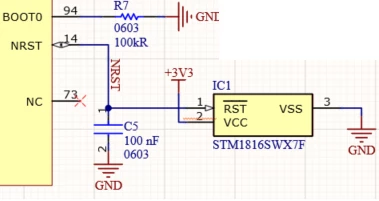
Could anybody please look at the circuit, and if it is correct.

I am not sure if C5 is necessary to be there.

0693W00000HrgA7QAJ.pngThank you.

    This topic has been closed for replies.
    Best answer by Peter BENSCH

    The reset devices were not developed as an addition to the STM32, but for other devices that still need an external reset and that too with the old method of a pull-up, as was often used in the last century.

    In this respect, the internal pull-up is nice, but redundant in the context of the STM32 - as, by the way, is the external reset device. All STM32s have a comparable reset circuit and external pull-ups are redundant on the NRST.

    At NRST you only need the 100nF capacitor, if you also want to trigger a manual reset, you can also connect a button - preferably with a 100 ohms series resistor to protect the button contact.

    Regards

    /Peter

    7 replies

    LCE
    Principal II
    January 14, 2022

    STM181x website:

    • Open-drain, active-low (STM1811,1816)

    I don't know about the STM32's internal pull-up resistor on NRST, but I would definitely place one, something like 10k between NRST and +3V3.

    And then 100nF would be really over the top, I usually place some 100pF just for deglitching and for... it's always good to have the option to place a cap somewhere. ;)

    Peter BENSCH
    Technical Moderator
    January 14, 2022

    If you really want to use an external reset device in addition to the internal reset circuit, you don't need C5 (if the line to NRST is not too long).

    Is there a reason you need to use an external reset?

    And no, contrary to what @Community member​  says, you definitely don't need a pull-up at NRST.

    Regards

    /Peter

    In order to give better visibility on the answered topics, please click on Accept as Solution on the reply which solved your issue or answered your question.

    LCE
    Principal II
    January 14, 2022

    That's why I wrote "I don't know about the STM32's internal pull-up resistor on NRST"...

    Have all STM32 types the (almost) same NRST input circuit with a weak pull-up?

    The OP didn't give the exact STM32 type, and I wouldn't trust something I haven't checked.

    NASI
    NASIAuthor
    Associate III
    January 14, 2022

    Thank you for your respond @Community member​  and @Peter BENSCH​ 

    I don't need a pull-up at NRST, I am agree. As STM1816 has a pull-up inside.

    0693W00000HrgI1QAJ.pngI don't have any reason to use an external reset. The NRST is connected to be used in debug reset, and therefore I thought maybe it is good to have an extern reset.

    Thank you.

    LCE
    Principal II
    January 14, 2022

    Okay, interesting that also the STM1816 has an internal pull-up.

    I once did the mistake and thought that an "open-drain" labelled device would come with an internal pull-up, and it did not.

    Peter BENSCH
    Peter BENSCHBest answer
    Technical Moderator
    January 14, 2022

    The reset devices were not developed as an addition to the STM32, but for other devices that still need an external reset and that too with the old method of a pull-up, as was often used in the last century.

    In this respect, the internal pull-up is nice, but redundant in the context of the STM32 - as, by the way, is the external reset device. All STM32s have a comparable reset circuit and external pull-ups are redundant on the NRST.

    At NRST you only need the 100nF capacitor, if you also want to trigger a manual reset, you can also connect a button - preferably with a 100 ohms series resistor to protect the button contact.

    Regards

    /Peter

    In order to give better visibility on the answered topics, please click on Accept as Solution on the reply which solved your issue or answered your question.
    NASI
    NASIAuthor
    Associate III
    January 14, 2022

    Thank you @Peter BENSCH​