YFANG.2
Associate III
April 25, 2022
Solved

Leakage current of STM32U585VIT3Q I/O when the Micro is not powered

Hello

In my application, I use the DAC of the Micro to charge a capacitor(47uF). When the micro is power off, the voltage on the capacitor start to discharge with a high impedance resistor(6.8Megohm). I want the leakage current of the Micro I/O small enough. As I don't want the leakage current impact the capacitor discharge time.

Thanks!

This topic has been closed for replies.
Peter BENSCH
Peter BENSCHBest answer
ST Technical Moderator
April 25, 2022

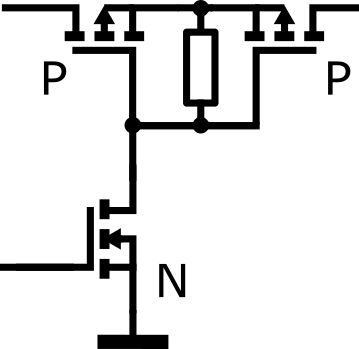
Yes, kind of this:

0693W0000059PcwQAE.png 

Of course, the layout must also be low-leakage. The gates must be controlled via a MOSFET or a bipolar npn and not directly from a GPIO, because otherwise the gates cannot be switched off cleanly.

Regards

/Peter

In order to give better visibility on the answered topics, please click on Accept as Solution on the reply which solved your issue or answered your question.

5 replies

Peter BENSCH
ST Technical Moderator
April 25, 2022

Of course, the technical data of the STM32 only apply when they are supplied with operating voltage. Every other case, including yours, must be considered separately or solved externally.

Possibilities would be, for example, anti-serially switched p-channel MOSFETs between the DAC output and the capacitor, whose interconnected gates are controlled by an n-channel MOSFET, which in turn is controlled by a dedicated GPIO. Also, a relay or reed contact would be able to disconnect the DAC from the capacitor.

Does it answer your question?

Regards

/Peter

In order to give better visibility on the answered topics, please click on Accept as Solution on the reply which solved your issue or answered your question.
YFANG.2
YFANG.2Author
Associate III
April 25, 2022

Hi Peter

I am not fully understand. Do you mean to add an anti-serially switched mosfet to minimize the leakage current? Do you have the relevant circuit for reference?

Peter BENSCH
Peter BENSCHBest answer
ST Technical Moderator
April 25, 2022

Yes, kind of this:

0693W0000059PcwQAE.png 

Of course, the layout must also be low-leakage. The gates must be controlled via a MOSFET or a bipolar npn and not directly from a GPIO, because otherwise the gates cannot be switched off cleanly.

Regards

/Peter

In order to give better visibility on the answered topics, please click on Accept as Solution on the reply which solved your issue or answered your question.