


Zt Liu
Senior III
June 8, 2017
Question

Concerning ST-Link on Nucleo Board

  • June 8, 2017
  • 1 reply
  • 1560 views
Posted on June 08, 2017 at 17:33

hi,  fellows!

I have some questions about ST-Link, especially those on Nucleo boards.

First, I often use the on board st-link link to debug/program some other custom boards, it works fine.

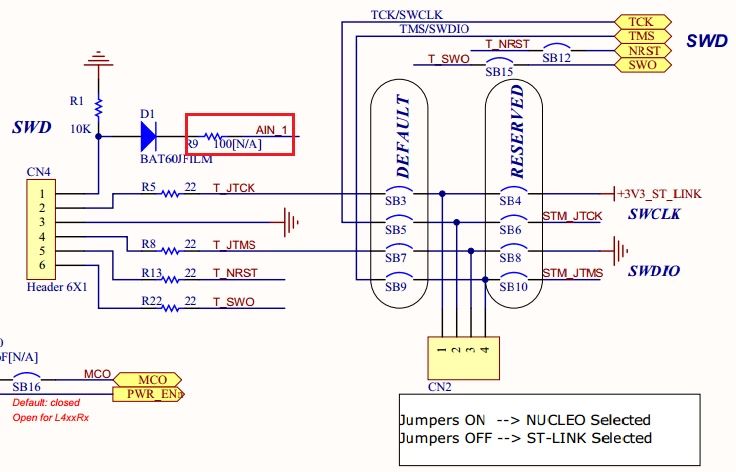
But someday, I'd noticed that the debugger's AIN_1(target VCC) is never  really connected to the MCU VCC

of the application board, for R9 is not lying there. See below:
0690X00000607H3QAI.png

From the UM1075 User manual of ST-Link, it says:

The power supply from the application board is connected to the ST-LINK/V2 debugging and programming board to ensure signal compatibility between both boards.

So is this really unnecessary? (For me, the debugger/programmer works fine so far.)

Or is this risky for some reason?

I really need to know about this!

For we are making a project with the whole nucleo board as a part,

 with st-link on it.

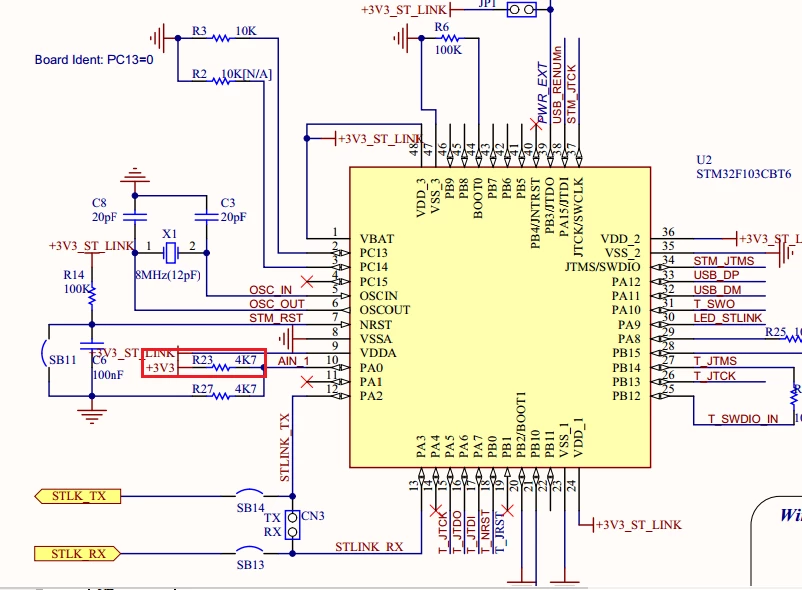
And I've already removed R23 for saving power.

See below:
0690X00000602TEQAY.bmp

Thanks for reading the post!

Zt

#debugger #st-link #programmer #nucleo
This topic has been closed for replies.

1 reply

Tesla DeLorean
Guru
June 8, 2017
Posted on June 08, 2017 at 20:00

The stand-alone ST-LINK has buffers so that the debugger and the target board can run at different voltages. The NUCLEO/DISCO boards don't have these buffers, and just use/assume the use of 3.0V or 3.3V signalling.

Most of the pins are 5V tolerant, and the VIL/VIH vs VOL/VOH provide a lot of leeway.

The idea would be to avoid back-feeding current into a processor via the GPIO pins and skewing the current measurements.

If the target STM32 were running at 1.25V I'd probably want the buffers

Tips, Buy me a coffee, or three.. PayPal VenmoUp vote any posts that you find helpful, it shows what's working..
Zt Liu
Zt LiuAuthor
Senior III
June 9, 2017
Posted on June 09, 2017 at 01:14

Thanks Clive, as always!

So since my target MCU is running at 3.0/3.3V, there is a lot of leeway.

Guess I can sleep well with the target VCC pin left open! 

:)