

dming.4
Associate II
October 25, 2019
Solved

Why stm32f2 bootloader check application always failed?

  • October 25, 2019
  • 3 replies
  • 1079 views

Hello:

I use this to check the address is application in stm32f207VET6.

void go2APP(void) {
 uint32_t JumpAddress;
 pFunction Jump_To_Application;
 
 //Check
 if (((*(__IO uint32_t*) FLASH_APP_ADDR) & 0x2FFE0000) == 0x20000000) {
 printf("APP Start...\n");
 HAL_Delay(100);
 // Jump to user application //
 JumpAddress = *(__IO uint32_t*) (FLASH_APP_ADDR + 4);
 Jump_To_Application = (pFunction) JumpAddress;
 // Initialize user application's Stack Pointer //
 __set_MSP(*(__IO uint32_t*) FLASH_APP_ADDR);
 Jump_To_Application();
 } else {
	 printf("No APP found!!!\n");
 }
}

When i erase the whole chip i get this
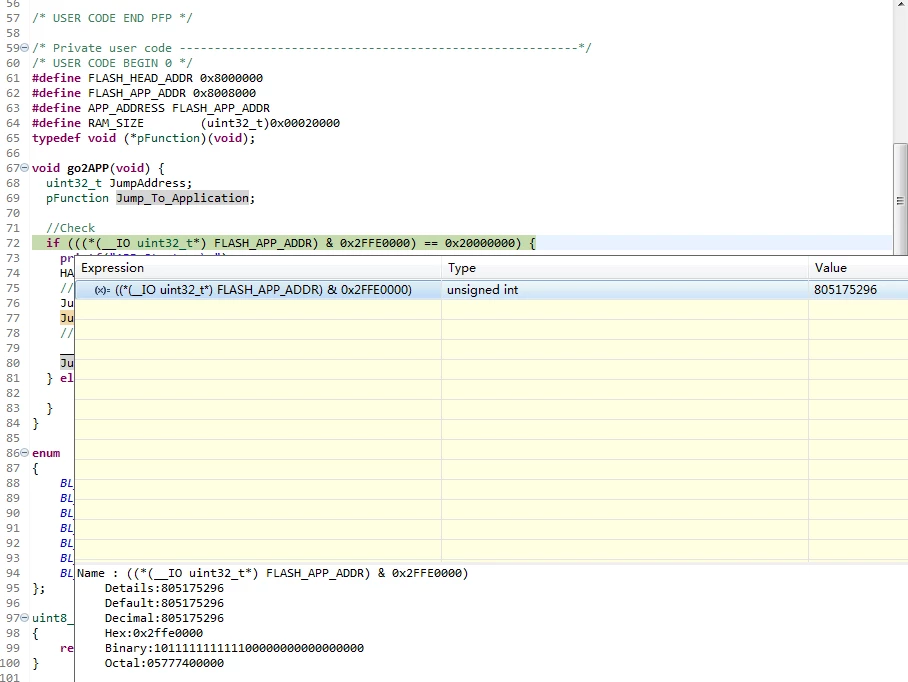
 0690X00000AqsOzQAJ.png

But when i use jflash to program an application hex to the application address

I get this
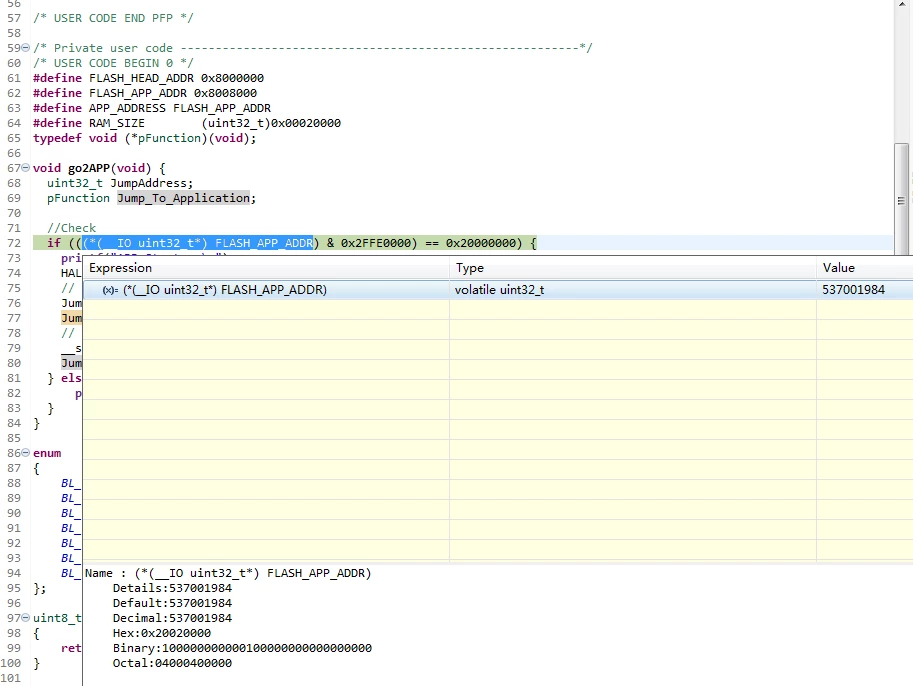
0690X00000AqsOBQAZ.png

Even i use the flash base address to check but also get 0x20020000 .

Should i change the 0x2FFE0000 to 0x2FFD0000 ?

Thank you

This topic has been closed for replies.
Best answer by Tesla DeLorean

Perhaps just mask with 0xFFF00003, all the test is doing is ensuring that the stack pointer is in RAM, it is a crude test, and perhaps a hold-over from parts with smaller memories. Keil doesn't place it at the end of memory, but at the end of the allotted space the linker knows about. GNU/GCC typically places it at the top-of-RAM, but a lot of ST scripts are defective and use an unaligned address. The address pre-decrements, so you can park it just beyond, ie for 128KB system you use 0x20020000, and not 0x2001FFFF

3 replies

TDK
October 25, 2019

Why do you think that check should pass?

If you’re trying to test if it’s something other than 0xFFFFFFFF just do that instead.

"If you feel a post has answered your question, please click ""Accept as Solution""."
dming.4
dming.4Author
Associate II
October 25, 2019

you should see the second picture before you type something.

My question is why i flash the application to the 0x8008000 but could not pass the check.

TDK
October 25, 2019
Okay, good luck.
"If you feel a post has answered your question, please click ""Accept as Solution""."
dming.4
dming.4Author
Associate II
October 25, 2019

/

Tesla DeLorean
Tesla DeLoreanBest answer
Guru
October 25, 2019

Perhaps just mask with 0xFFF00003, all the test is doing is ensuring that the stack pointer is in RAM, it is a crude test, and perhaps a hold-over from parts with smaller memories. Keil doesn't place it at the end of memory, but at the end of the allotted space the linker knows about. GNU/GCC typically places it at the top-of-RAM, but a lot of ST scripts are defective and use an unaligned address. The address pre-decrements, so you can park it just beyond, ie for 128KB system you use 0x20020000, and not 0x2001FFFF

Tips, Buy me a coffee, or three.. PayPal Venmo (See Profile) Up vote any posts that you find helpful, it shows what's working..