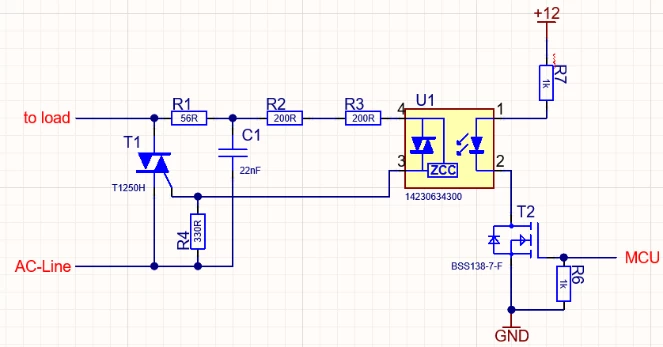
The zero-cross function influences the ripple indirectly, but the main factor is still whether the power triac receives enough gate current early enough to fire reliably. For a boiler load, your T1610T-8I + ZC optotriac approach looks OK and is a good topology.
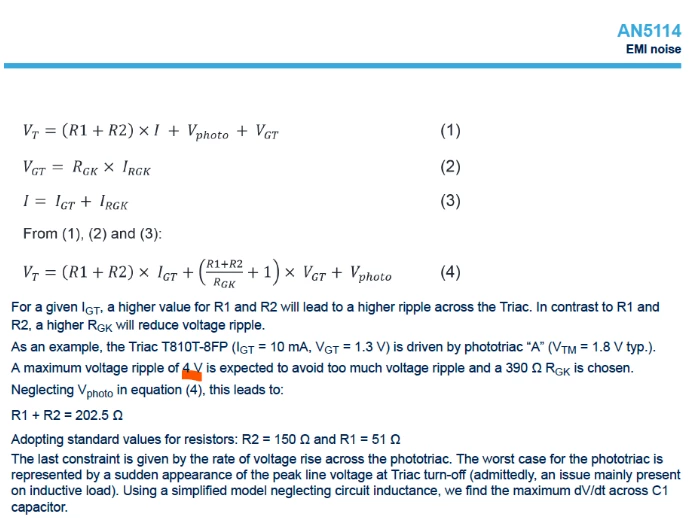
A ripple of 5.6V is not necessarily a problem. The 4V value in AN5114 is best seen as a practical target, not a strict limit. What matters most is:
- reliable turn-on over all tolerances
- acceptable EMC behaviour
- no false triggering
- sufficient thermal margin
You should focus more on:
- worst-case gate current
- the values of the series resistors and RGK
- EMC measurements
- thermal performance
rather than on the ripple value alone. R1, R2 and RGK should not be chosen too conservatively. Smaller values improve triggering on the one hand, but they also increase current peaks, the load on the optotriac, and may cause EMC problems.
If you absolutely need zero crossing but want to use an optotriac without ZC, you could consider handling the ZC detection with the controlling MCU, which is quite feasible with a predominantly resistive load like your boiler. Advantages:
- wider component choice
- more flexible gate timing
- potentially better optimisation of ripple and EMC
Trade-offs:
- more design complexity
- stricter safety and isolation requirements
- timing tolerances in hardware and software
- more validation effort
Regards
/Peter
In order to give better visibility on the answered topics, please click on Accept as Solution on the reply which solved your issue or answered your question.