Hi @WSega.1 and welcome to the ST Community !
Seems to me that everything is working fine.
You are measuring the HS gate driver referred to GND so it is expected that double step 36V down to 24V.
The HS driver works respect to OUT_x pin (the coil of the motor), that is the source of the HS MOSFET.
Indeed, the gate driver drives the Vgs of the MOSFET, that is the reason why the HS driver is refereed to OUT (coil) instead of GND.
Here is your screenshot adding 3 reference points described here below:
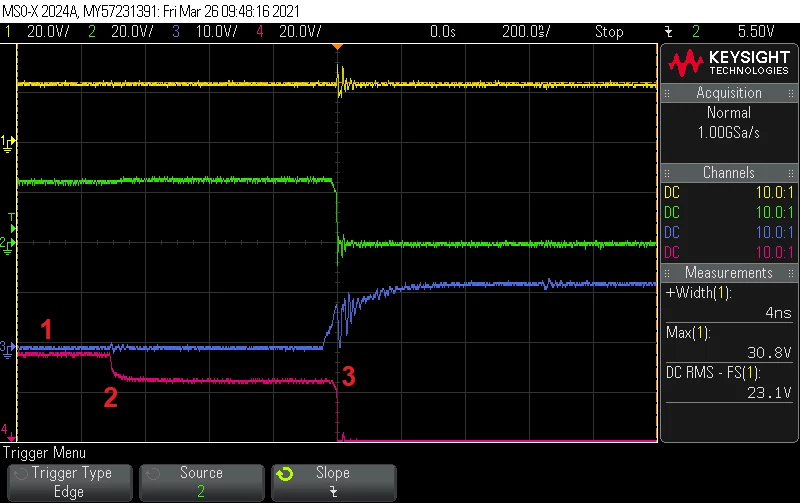
- HS driver on, LS driver off, and OUT pin (Coil) at the supply voltage 24V. The voltage of the gate drivers, hence the target Vgs of the MOSFETs, is 12V. So, you have the HS driver at 24V + 12V about 36V on CH4.
- Turn off the HS driver but the OUT pin is still high at 24V (probably current is flowing in the HS, turning on the bulk diode of the HS). In this case the HS gate driver stays goes to 24V (0V respect to OUT).
- After the deadtime, the LS driver turns on (up to 12V), the OUT falls to 0V and consequently the HS driver falls to 0V in the same way.
Basically the bootstrap capacitor is referred to the OUT node, and when it switches high to the supply (24V in the example) it can provide a voltage higher than the supply itself.
When the HS driver is on, the bootstrap capacitor slowly discharges: this is the reason why it is not possible to keep on continuously the HS MOSFET.
Of course this is a limitation, but not so critical in many switching systems.
The size of the bootstrap capacitor basically depends on the maximum time your application needs to keep on the HS driver, the total gate charge of the MOSFET driven and the maximum drop allowed on the bootstrap voltage.
I hope this explanation can solve your doubts; if so, consider to mark this post as "best answer" by clicking the label here below.