

L9963E failure hypothesis: intermittent open connection on C13 sense wire during external balancing
Hello,
We are investigating a field failure of a BMS board based on the L9963E cell monitoring IC.
The system uses a 14-cell stack. Passive balancing is implemented with external balancing resistors and MOSFETs. The balancing resistors are located on a separate resistor board. The balancing resistor value is 10 Ohm / 3 W. The external balancing MOSFETs are BSS308PE P-channel MOSFETs (and PMV55ENEAR N-channel).
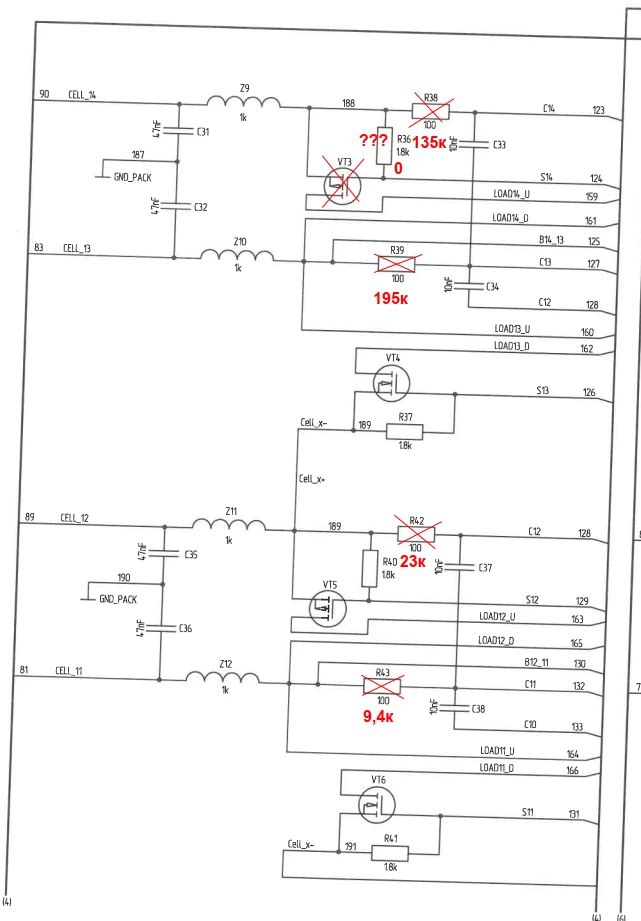
After the failure, we found damage mainly in the upper cell channels, especially around the C14 / C13 / S14 area. Several 100 Ohm series resistors in the cell input/filter network were damaged, and one of the balancing MOSFETs (VT3) was shorted.
We also found a mechanical/electrical issue in the battery harness: the C13 sense wire connection is intermittent. With the harness connected, the C13 contact sometimes exists and sometimes disappears. The failure reportedly occurred when the vehicle hit a bump, so vibration-related contact loss is possible.
Our hypothesis is the following:
- Balancing of the cell connected to the C13/C12 area was active, or had recently been active.
- The C13 sense wire temporarily opened due to the intermittent contact.
- The C13 node on the BMS board lost its real battery potential.
- Because the balancing MOSFET was on, the floating C13 node could be pulled toward C12 through the 10 Ohm balancing resistor path.
- As a result, the L9963E could see approximately 0 V on C13-C12 and approximately two cell voltages on C14-C13.
- This may have caused the internal protection/clamp structures of the L9963E to conduct, leading to high current through the input resistors and the external balancing circuit.
- This could explain the damage pattern around C14/C13/S14 and the shorted external balancing MOSFET.
Could you please comment on whether this failure mechanism is plausible for the L9963E?
In particular:
- Can an intermittent open-wire condition on an intermediate cell connection such as C13, while external balancing is active, lead to destructive current paths through the L9963E input or balancing pins?
- Is the open-wire diagnostic intended only to detect this condition, or should the IC also survive such a condition without external hot-plug/open-wire protection?
- Should balancing always be disabled before and during open-wire diagnostics?
- Are there recommended external protection circuits or design rules for cell sense lines when external balancing resistors/MOSFETs are used, especially to survive contact bounce or hot-plug events?
- Are there any specific recommendations for protecting the Cx/Sx pins against this type of intermittent harness fault?
Any guidance or references to the relevant application notes would be appreciated.
Best regards, Dmitrii.