


Andrew Neil
Super User
May 12, 2026
Solved

STM32F030: Current rises after putting TI CC1125 to SLEEP and entering STANDBY.

  • May 12, 2026
  • 6 replies
  • 799 views

Cross-posting from CC1125 Sleep current rises to ~2mA on the TI forum.

I have a custom board with STM32F030 controlling a TI CC1125 sub-GHz radio transceiver via SPI plus a few GPIOs.

Everything is fine for normal operation (TX, RX, etc), but the system has a "Shutdown" mode where the CC1125 is put into its low-power SLEEP state, and the STM32 is in STANDBY.

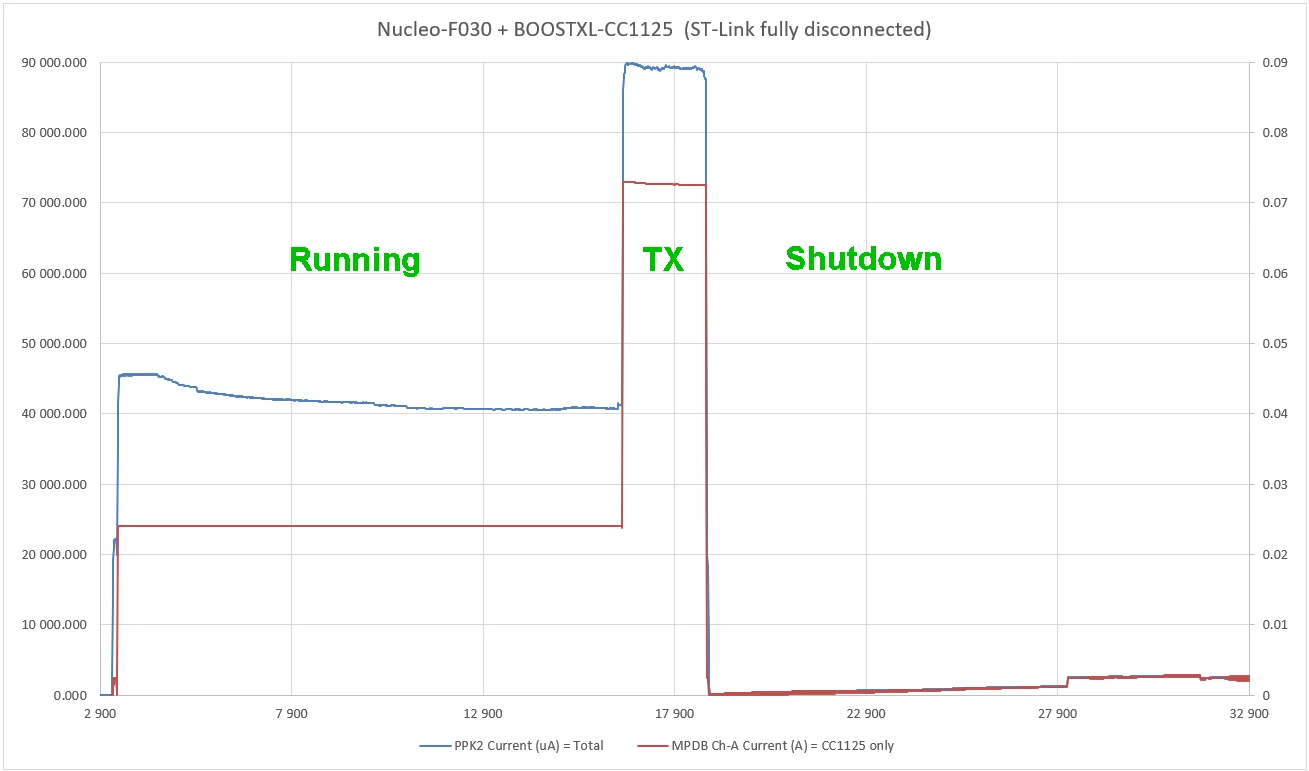
In SLEEP the CC1125 should take under 1uA but, after sending the SLEEP command, I see the current rise over ~4s and eventually settle at ~2mA.

I have managed to reproduce this using a Nucleo-F030R8 (ST-Link removed) and a TI dev board:
AndrewNeil_0-1778598375436.png

The blue line is the total system current (STM32 + cc1125); red line is just the CC1125.

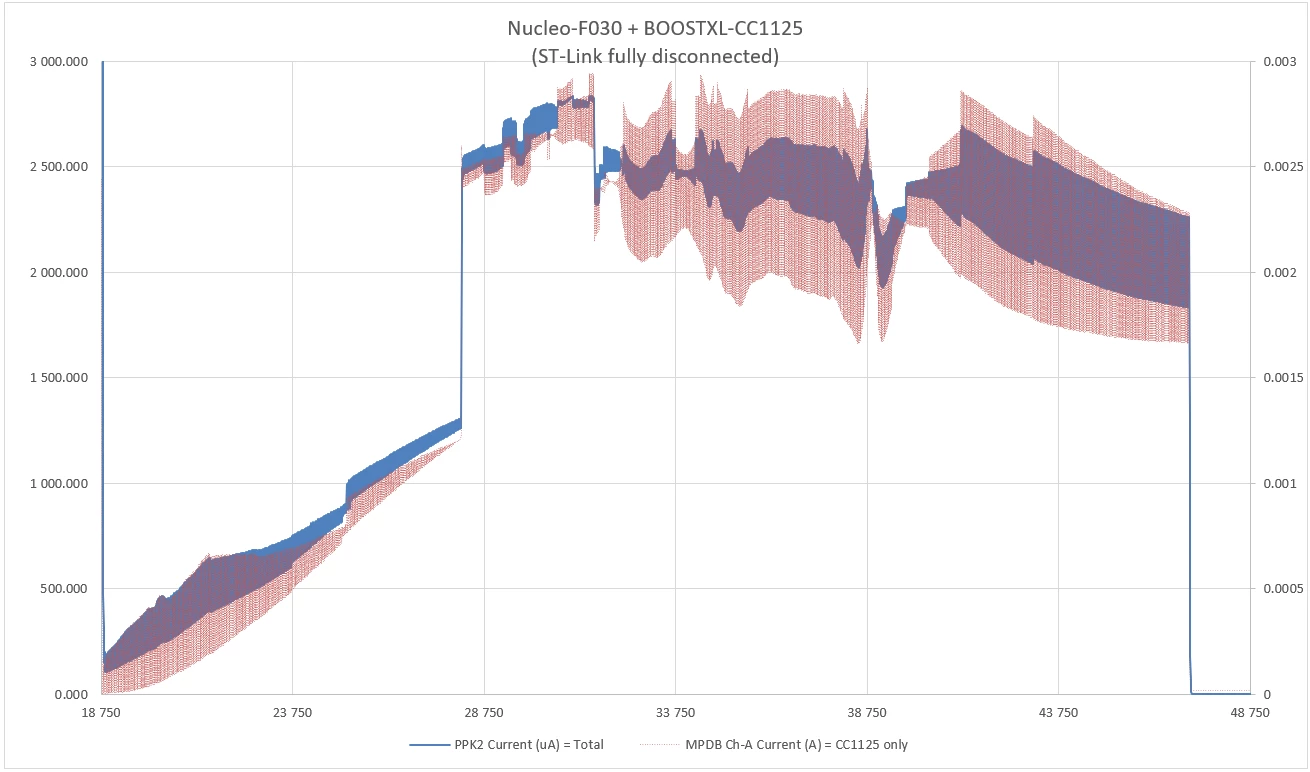
Zooming-in on the Shutdown part:
ppk2-mpdb-2026-0511-1826-shutdown.png

There seems to be something charging-up and then (partially?) switching-on?

With the CC1125 disconnected, the Nucleo alone takes a steady ~3.1uA with the STM32 in STANDBY.

So it looks like the issue is with the CC1125 somewhere; just posting here in case anyone has any suggestions.


Full details are in the TI forum post.

Best answer by waclawek.jan

Just a blind shot: some floating pin?

JW

6 replies

waclawek.jan
waclawek.janBest answer
Super User
May 12, 2026

Just a blind shot: some floating pin?

JW

Andrew Neil
Super User
May 12, 2026

I don't think so - I think I've been through all the options!

A complex system that works is invariably found to have evolved from a simple system that worked.A complex system designed from scratch never works and cannot be patched up to make it work.
waclawek.jan
Super User
May 12, 2026

Physically measuring them?

Like poking around with an oscilloscope probe during those 4 seconds, or maybe even beyond them?

Andrew Neil
Super User
May 12, 2026

Now I've got it reproduced on devboards with accessible pins, that's the next step...

A complex system that works is invariably found to have evolved from a simple system that worked.A complex system designed from scratch never works and cannot be patched up to make it work.
waclawek.jan
Super User
May 12, 2026

oh, but that chip is QFN, the "pins" are basically accesible;  so that's just a sharp pin at the end of the probe, a steady hand, and possibly a good loupe... :):)

aren't most of the signals accessible at the surrounding resistors/capacitors anyway?

[EDIT]

also, is the chip completely "dumb" in the sleep/"high-current shutdown", or could it be queried through SPI from the STM32? I mean, not according to the manual, but try experimentally...