Hi:
1. The datasheet description of C5/MISO refers to the pin output structure
The sentence: SPI: Main input secondary output. Push-pull output, driven to IOVDD level. means that:
when C5 is used as SPI MISO:
this pin is a digital output,
its output stage is push-pull,
and its high-level output is driven to the IOVDD voltage domain.
In other words, the internal driving capability of the chip will actively pull this pin up/down
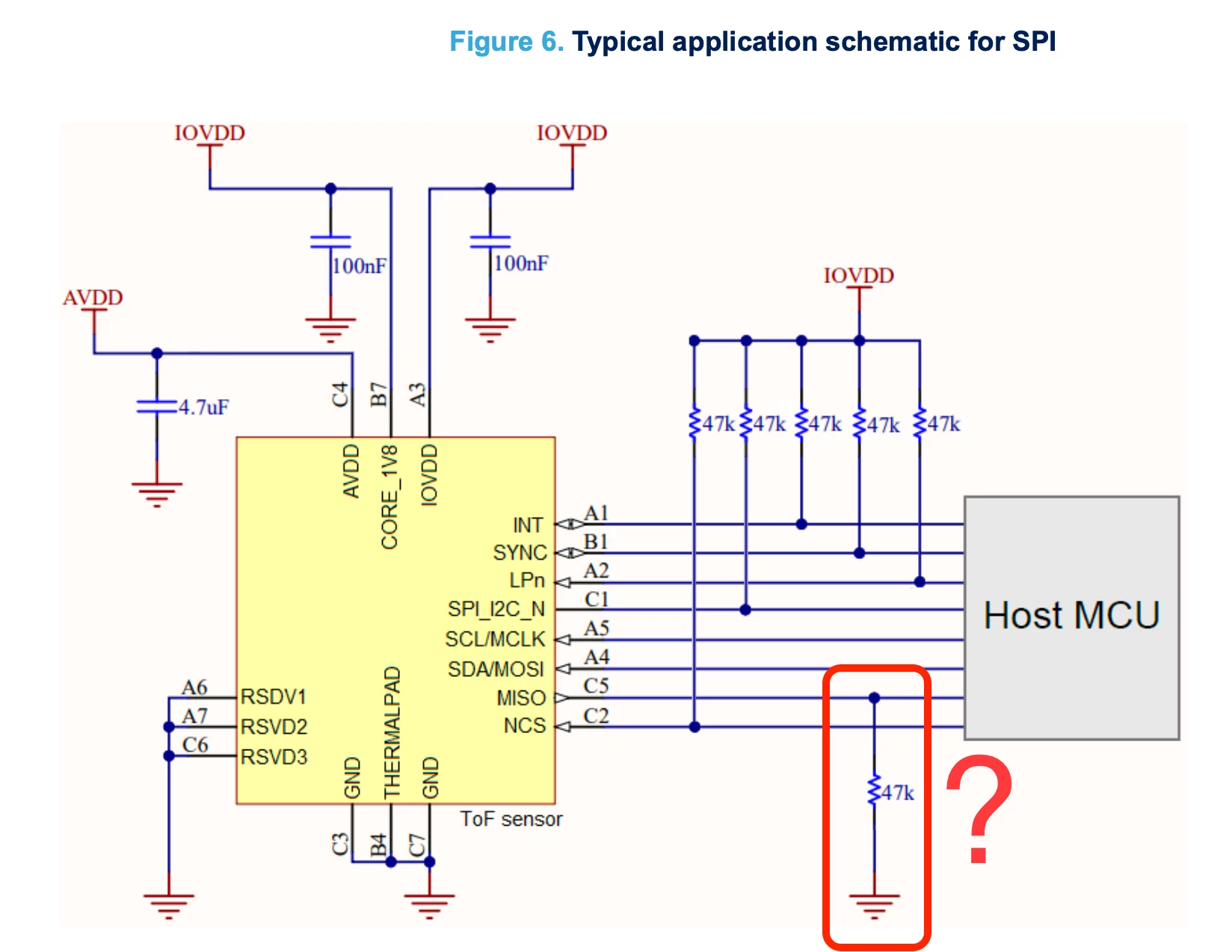
2. The 47 kΩ resistor in Figure 6 refers to the board-level default state / startup behavior
The 47 kΩ pull-down to GND shown in the schematic does not mean that MISO depends on it for normal operation, and it does not imply that MISO is open-drain.
It is better understood as a weak pull-down, used to give the line a defined default state in certain conditions.
Typical reasons for such a resistor are:
to prevent the line from floating during power-up or reset
to provide a defined low level when the sensor is unpowered or its I/O is in high-impedance
to reduce noise susceptibility
to avoid undefined logic states during startup or multifunction-pin transitions
3. Why can a push-pull output still have an external pull-down resistor?
Because 47 kΩ is a large resistance, so it acts only as a weak bias.
When the VL53L8CX actively drives MISO high:
the output high level is approximately IOVDD
the pull-down resistor only sinks a very small current
For example, if IOVDD=3.3V:
I≈70 μA
This current is very small, so it has essentially no practical impact on a push-pull output.
So:
when MISO is low: the sensor actively pulls it low, and the resistor is simply consistent with that state
when MISO is high: the sensor actively pulls it high and only needs to overcome about 70 μA of pull-down current.
Therefore, both can coexist without issue.
4. What is the key purpose of this 47 kΩ pull-down?
The important point is:
the resistor only matters when no one is actively driving the pin.
That includes cases such as:
the sensor is not powered
the sensor is in reset
SPI is not yet active
the pin is temporarily in high-impedance state
In those situations, the MCU does not see a floating MISO pin. Instead, the 47 kΩ resistor forces it to a defined low level.
Once the VL53L8CX is operating normally and driving MISO, the pin state is determined by the internal push-pull driver, not by the resistor.
Hope my explanation will help for you.
In order to give better visibility on the answered topics, please click on 'Accept as Solution' on the reply which solved your issue or answered your question.


 But in Figure 6 (“Typical application schematic for SPI”), the MISO line seems to have a 47 kΩ pull-down resistor to GND.