Get ready for the STM32 Summit 2026 | Online, November 3
Stay ahead of the latest technical news & updates.
Most recent activity
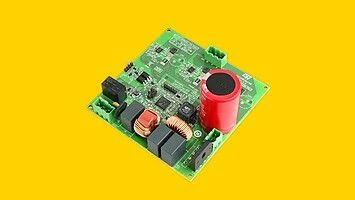
The EVSTDRVG611MC gallium-nitride (GaN) motor-control reference design for appliances and industrial drives handles more than 600W without a heatsink, ensuring a compact outline and low build cost. Available as a turnkey board, ready to power up and evaluate, the reference design combines ST’s STDRIVEG611 GaN driver ICs, discrete GaN power transistors, and a mixed-signal STM32G431 microcontroller. The bill of materials (BOM) and schematics, as well as gerber files for the economical 2-layer 108mm x 110mm board, are ready to download from st.com. ST’s GaN high electron-mobility transistors (HEMT) and driver ICs are already transforming power conversion, enabling chargers, adapters, and server PSUs, to reach efficiency and power density unachievable with silicon technology. The STDRIVEG611 gate drivers in the EVSTDRVG611MC reference design are tailored for hard switching to facilitate GaN adoption in motor controls. By combining these drivers with 650V 75mΩ GaN transistors, the board let
STM32Cube embedded software for the STM32C5 series introduces an upgrade of drivers and tools to help you design faster, smaller, and more robust products. Core software stackSTM32Cube for STM32C5 is built around:New software drivers with two levels of hardware abstraction: HAL2 (HAL v2.x) LL (Low‑Layer) APIs RTOS support Middleware components Utilities Part drivers / BSPThis stack lets you:Leverage STM32 hardware features and performance with HAL2 to differentiate your product. Accelerate development with the new STM32 Example Library, giving quick access to hundreds of examples for your STM32 device. Reduce cost by reusing STM32Cube components free of charge under user‑friendly license terms. HAL2: next‑generation hardware abstraction layerWhile keeping the same programming model as STM32 HAL (HAL v1.x) for easy porting, the STM32 HAL2 driver brings the following enhancements:Lower footprint Improved intuitiveness and usability Finer service granularity Better integration with
Motor-control software has been released to simplify enhancing drives with AI for optimization and predictive maintenance, ready to load on the EVLSPIN32G4-ACT evaluation board and start exploring. The FP-IND-MCAI1 function pack helps designers navigate the workflow and tools for implementing smart capabilities in industrial drives and servos, home appliances, robotics, and diverse types of actuators. The software includes a sample application to drive a low-voltage three-phase brushless motor with field-oriented control (FOC), HAL and board-specific drivers, and a machine-learning (ML) solution for motor-behavior classification. The ML model is preconfigured to identify normal, high-vibration, and unstable motor conditions. Providing a convenient hardware platform, the EVLSPIN32G4-ACT drives 3-phase brushless DC motors up to 250W and provides connections for a vibration-sensing module such as the STEVAL-C34KAT1 or STWIN.box multi-sensor kit. Users can parameterize and interact with th
Built on the Arm® Cortex®‑M33 core, the STM32U3B5/U3C5 MCUs combine up to 2 Mbytes of dual‑bank flash memory with 640 Kbytes of RAM and are available in packages from 48 to 144 pins (UFQFPN, WLCSP, LQFP, and UFBGA). The lines introduce a hardware signal processor (HSP) to the STM32U3 portfolio, offloading complex DSP and edge‑AI workloads and improving performance, efficiency, and security, all while remaining optimized for compact, battery‑powered devices. To support evaluation and rapid prototyping, the new NUCLEO‑U3C5ZI‑Q Nucleo board is also available. 1. High‑performance DSP and what this means for you: Much faster DSP execution compared to Cortex®-M33 alone Smoother real‑time analytics Higher sampling rates More CPU headroom for your application logic Key improvements Up to 12× faster DSP workloads (vs Cortex‑M33 alone) Around 3× boost in overall DSP performance (vs Cortex‑M55) Best‑in‑class FIR/RFFT acceleration Significantly better DSP power efficiency while staying ultra‑lo
The STM32WBA2 extends the STM32WBA family with a more integrated, cost-effective MCU for low-power wireless devices. As the most affordable STM32 wireless MCU supporting Bluetooth® LE and IEEE 802.15.4, it adds improved wireless features and new communication interfaces while staying fully compatible with existing products. Powered by an Arm® CortexM33 at 64 MHz, it provides a compact and efficient platform for flexible wireless applications. Improved wireless performance for robust IoT designs High‑performance radio delivering stable connectivity with +10 dBm max output power Supports Bluetooth® LE, Zigbee, and Thread for broad protocol compatibility Programmable Tx power in 1 dB steps to precisely tune energy consumption and extend battery life Flexible power‑control leveraging ultra-low-power STM32 MCU architec
ST announces the release of TouchGFX 4.26.0, an update that brings a range of enhancements and fixes, designed to improve development workflows and application performance. Below is a detailed overview of the key updates included in this release. User interface improvements This version introduces several minor but valuable user interface (UI) enhancements aimed at making everyday tasks more intuitive and efficient. These improvements address common developer needs and help reduce repetitive actions. Notable examples include: Copying typographies: you can now more easily duplicate typography settings, saving time when working with multiple text elements that share styles. Reordering and cloning interactions: the process of organizing and replicating interactions within your UI projects has been streamlined, allowing for quicker adjustments and better project management. Clang compiler support TouchGFX 4.26.0 introduces support for the Clang C++ compi
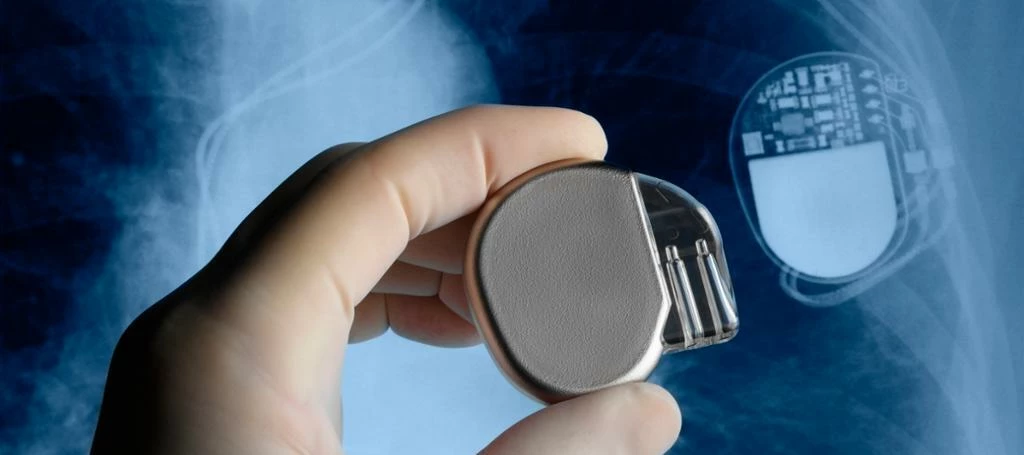
MIS2DU12 MEMS accelerometer combines ultra-low power, signal processing, and an ultra-low profile suitable for wearable and implantable medical applications. Produced using biocompatible materials and manufacturing processes, the MIS2DU12 has a 20nA power-down and sub-1µA active mode to extend the operating envelope of implantables such as cardiac monitors and pacemakers. At only 0.74mm high, and 2mm x 2mm, it enables skin patches to become extremely slim, lightweight, and comfortable to wear. In skin patches such as glucose monitors and other bio-parameter sensors, the MIS2DU12’s ensures precision even during macroscopic motion and environmental stress. The applications benefit from high micro-motion sensitivity, power efficiency. The dedicated internal engine for motion processing detects free-fall, wake-up, single/double-tap, activity/inactivity, and calculates 6D/4D orientation. There are also built-in self-test and an embedded temperature sensor. With integrated motion processing
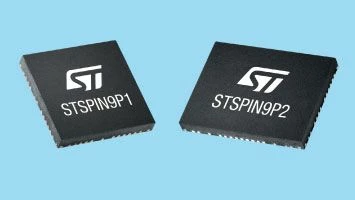
The STSPIN9P series of 75V motor-drive ICs accelerates development of robust industrial drives. Suited to operation from popular bus voltages such as 48V, the 12 STSPIN9P devices let users conveniently scale their designs for different motor types and power ratings up to 500W. The new STSPIN9P1 half-bridge and STSPIN9P2 full-bridge devices extend the STSPIN family that helps developers ensure motor-control applications begin turning quickly to allow testing and fine-tuning. Their wide operating-voltage range and output-current rating up to 10A allow use in industrial automation and robotics, as well as appliances, stage lighting, pumps, fans, and textile machines. The IC is powered entirely from the main bus, at a voltage from 7V to 75V, permitting a simplified system design and PCB layout. Integrated regulators supply the internal circuitry, including the control logic and gate drivers, and a charge pump supplies the high-side enabling 100% duty-cycle operation. Analog front-end circu
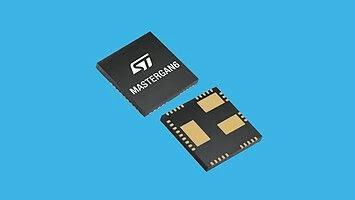
STMicroelectronics has introduced MasterGaN6, beginning the second generation of the MasterGaN half-bridge family. The new power system in package couples an updated BCD driver with a high-performance GaN power transistor that has just 140mΩ RDS(on). Leveraging the high integration already established with ST’s MasterGaN family, MasterGaN6 enlarges the feature count by including dedicated pins for fault indication and standby functionality. While these features enable smart system management and enhance power savings, the new devices also integrate LDOs and a bootstrap diode to ensure optimal driving while saving on external components. Engineered with very fast timing, the new advanced driver allows high-frequency operation thanks to its low minimum on-time and propagation delays, helping designers minimize circuit footprint. Moreover, its ultra-fast wake up time enhances burst-mode operation for optimal low-load efficiency. With a full set of protections, including cross conduction,
TSC240 is a high-precision current-sense amplifier with elevated voltage tolerance and 120dB PWM rejection for accurate and reliable monitoring in automotive traction inverters, factory automation and robotics, and servers. The TSC240 handles common-mode voltages from -4V to 100V and is AEC-Q100 qualified, allowing use with industrial DC buses and established automotive boardnet standards including 12V, 24V, and 48V. The amplifier’s tolerance for high voltages reduces dependence on external components to provide protection. In addition, the gain is internally fixed at 20V/V thereby ensuring precision and repeatability while also saving external resistors. Designers can thus ensure a compact circuit footprint and minimize the bill of materials. Capable of bidirectional current sensing, the TSC240 offers outstanding precision, with maximum gain error of 0.2% and drift of 2.5 ppm/°C, offset voltage of just ±20µV, and drift of 150nV/°C. Its high common-mode rejection ratio (CMRR) ensures a
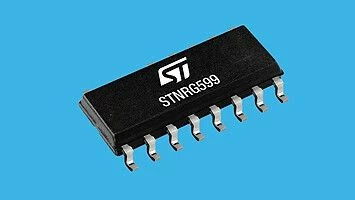
STMicroelectronics has introduced the STNRG599A and STNRG599B controllers for resonant-converter topologies with innovative phase-shift control (PSC) that boosts power-supply no-load efficiency and delivers flicker-free deep dimming in lighting applications. The STNRG599A is optimized for power conversion, with built-in X-capacitor discharge circuitry for safety in adapters, chargers, TV power supplies, and industrial power supplies. The STNRG599B, without discharge circuitry, targets circuits such as lighting drivers. The controllers operate up to 750kHz maximum frequency, with a wide input-voltage range to handle applications from 90W to several hundred Watts. In each IC, two complementary outputs drive external high-side and low-side switches 180° out-of-phase, with zero-voltage switching across the full operating range. ST’s PSC technique regulates the output by directly controlling the phase shift between the half-bridge voltage and the resonant-tank current. This reduces the cont
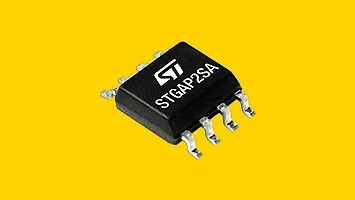
STGAP2SA and STGAP2HSA automotive-grade, galvanically isolated 4A gate drivers with 60ns response time and close part-to-part matching allow high switching frequencies for increased power density and efficiency. Suitable for IGBTs and silicon MOSFETs operating with a high-voltage rail up to 1200V, the drivers can sink/source 4A at up to 26V for unipolar or bipolar driving. Extending the STGAP series, ST's industrial and automotive galvanic isolated gate drivers, these AEC-Q100 qualified devices can handle a wide variety of applications throughout conventional, hybrid, and electric vehicles. Typical uses include DC/DC converters, pumps, fans, heaters, e-compressors, and on-board chargers (OBC). Other uses include wallbox and pedestal DC charging systems, as well as industrial inverters and motor drives. Featuring built-in protection, the drivers simplify design and enhance reliability, with under-voltage lockout (UVLO) and an output safe state during power-up and power-down. There is al
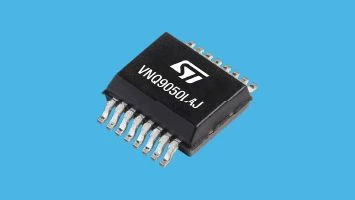
With 4V minimum operating voltage, STMicroelectronics’ VNQ9050LAJ 4-channel automotive high-side driver powers through disturbances including extreme cold cranking operation down to 2.7V, boosting vehicle reliability and ensuring superior user experiences. This resilience when exposed to severe transients meets the latest version of LV124, the automotive industry’s stringent quality standard for electrical and electronic components. Designed to power 12V ground-connected loads, the VNQ9050LAJ is compatible with 3V and 5V logic signals. Built with ST’s latest-generation VIPower-M09 technology, the driver has typical on-resistance as low as 50 mΩ to help boost efficiency and save energy. As an intelligent power switch, the VNQ9050LAJ brings further innovations to protect resistive, capacitive, and inductive loads. These include high-precision load-current sensing by implementing an on-chip current-mirror circuit with a sense-FET that closely tracks the main power-FET parameters. The curr
A new ultra-compact thyristor gate driver developed for small AC-powered appliances such as hairdryers, which features an innovative new isolation transformer that enables simpler, slimmer designs. The tiny new driver, STSID140-12, is housed in a 5.35mm x 3.45mm leadless DFN package only 1.2mm high. The transformer embedded in the device substrate ensures safety and reliability with an insulation voltage of 1250V (RMS) inside the minuscule dimensions. Also featuring enhanced immunity to interference, the STSID140-12 requires only minimal AC-input filter capacitance for conducted and radiation emission thereby saving more space and lowering the bill of materials (BOM). In addition, the surface-mount package is suited to automated assembly and saves manual wiring during product manufacture. Thyristors, or silicon-controlled rectifiers (SCRs), are proven and inexpensive in applications operated at domestic line voltages and frequency, including dimmers, heaters, and motor-driven appl
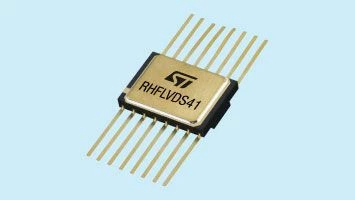
Supporting faster data speeds in space applications, ST’s RHFLVDS41 Low-Voltage Differential Signaling driver sets a new performance benchmark among QML-V qualified devices for data exchanges at up to 600Mbps. Having a wide operating-voltage range, from 2.3V-3.6V, the driver is compatible with the latest low-voltage logic and lower supply-voltage norms (TIA/EIA-644 and Jedec), as well as older CMOS devices. In addition to increasing performance and flexibility, the RHFLVDS41 also enhances resilience and reliability with 4.8V absolute maximum rating (AMR), 300krad/s maximum total ionizing dose (TID), and 8kV ESD immunity. Heavy-ion immunity parameters include single event latchup (SEL) free at 125MeV.cm²/mg and single event transient (SET) free at 62.5MeV.cm²/mg. The high-end 130nm pure CMOS technology is proven in space for more than 10 years. With a convenient flow-through pinout that helps utilize PCB space and equalize signal trace lengths, the RHFLVDS41 saves weight and wiring comp
The content of this blog article has been provided by arm Keil. Using STM32 devices with Keil Studio for Visual Studio CodeKeil Studio, Arm's latest IDE, integrates embedded development tools directly into Visual Studio Code. As the successor to µVision, it offers modern features including seamless industry tool integration, version control, and a CLI for CI workflows.Being part of Arm Keil MDK 6, Keil Studio provides comprehensive support for Cortex-M based microcontrollers, including the extensive STM32 family from STMicroelectronics. It combines the reliability and maturity of the Arm Compiler and extensive device support, with the flexibility and extensibility of Visual Studio Code. Get startedGetting started with Keil Studio is straightforward using the Create New Solution dialog in the CMSIS view. Select your STM32 board or device to access board-specific examples or templates for starting from scratch (with STM32CubeMX support). By default, the required tools and packs are insta
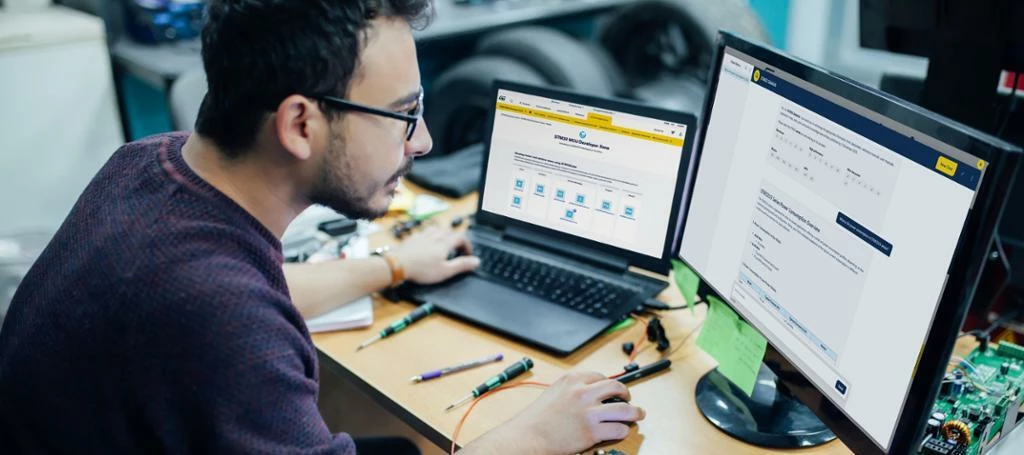
At the STM32 Summit, we announced STM32 Sidekick, an AI-powered tool that promises to accelerate productivity, helping developers spend less time searching and more time innovating.This brand-new AI agent assists engineers in efficiently locating relevant technical information, obtaining concise summaries of complex topics, and discovering documentation that might have previously gone unnoticed. It operates seamlessly within the community environment, delivering results in record time and ensuring availability 24/7in a self-sufficient manner.STM32 Sidekick is trained exclusively on official STM32 datasheets, reference manuals, user manuals, application notes, wiki entries, and community knowledge base articles.Here is a closer look at what STM32 Sidekick offers, how to maximize its benefits, and why it is worth integrating into your development workflow.What STM32 Sidekick offers Personalized suggestions: when you submit a query, STM32 Sidekick analyzes the context and recommends offi
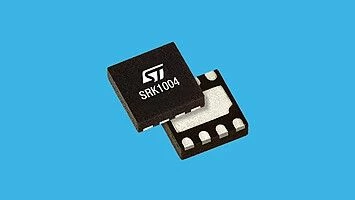
SRK1004 synchronous-rectifier controllers save space and increase efficiency in the secondary side of active-clamp, resonant, and quasi-resonant flyback (ACF, AHB, QR) converters for chargers, power adapters, and switched-mode power supplies. The minuscule 2mm x 2mm ICs supersede the SRK1001 and implement a new switch-off algorithm for increased efficiency and robustness.With six variants available, the SRK1004 series lets designers choose logic-level or standard MOSFET gate drive, and 25ns or 150ns turn-off delay to compensate for drain inductance. Suitable for active clamp, resonant and quasi-resonant flyback topologies, the controllers also contain circuitry that creates a turn-on window to prevent unwanted switching. The output can sink up to 1.6A and source 0.6A to the gate, while the switching frequency of 500kHz permits a compact and low-cost design. Leveraging ST’s robust silicon-on-insulator (SOI) process, the SRK1004 can control the MOSFET in either low-side or high-side conn
The ZeST software algorithm for STM32 allows sensorless motor drives to achieve full torque at zero speed. This innovation enables smooth and predictable motor control in general-purpose drives. Applications such as power tools, domestic appliances, and e-bikes require motors that can start quickly and with maximum torque. Traditional sensorless drives are unable to meet these demands as they cannot detect rotor position when stationary. The STM32 ZeST algorithm offers a solution that enables optimal sensorless control for any permanent magnet synchronous motor (PMSM) at zero speed, working in conjunction with the high-sensitivity observer (HSO) algorithm. This embedded software solution operates seamlessly without the need for extra hardware or special features in the microcontroller, and it dynamically estimates motor resistance for efficient control. The STM32 ZeST and HSO algorithms not only improve energy efficiency by reducing peak current during startup but also lower the b
The TSZ151 op amps have very low offset voltage with minimal temperature drift, offering high accuracy and stability to circuits for sensor interfacing, signal conditioning, and current measurement. An extremely low input offset voltage (Vio) is the defining parameter of a high-accuracy operational amplifier (op amp). The TSZ151 has Vio less than 7 µV at 25°C. Moreover, the value remains stable, below 10 µV, over the full specified temperature range, from -40 to 125 °C. Its high stability minimizes reliance on periodic recalibration, enhancing availability of the end product throughout its lifetime. With gain-bandwidth of 1.6 MHz and drawing just 210 μA at 5 V, the TSZ151 sits between ST’s 400 kHz TSZ121 and 3MHz TSZ181, giving designers more choice and flexibility to optimize speed and power consumption. The TSZ151 combines its excellent speed-to-power ratio with ultra-low maximum input bias current of 300 pA. Having a minimum operating voltage of 1.8 V, the TSZ151 can be powered fro
STM32 developers can now get more memory and extra features in STM32C0 microcontrollers (MCUs) to support more sophisticated functionality in resource-constrained and cost-sensitive embedded applications.Bringing up to 128Kbyte of Flash and 24Kbyte of RAM, the STM32C071 MCUs also add USB Host and crystal-less Device as well as TouchGFX support. With USB on-chip, designers can easily save at least one external clock and four decoupling capacitors to cut the bill of materials and ease PCB layout. Also, having only one power-supply pair helps to simplify the PCB design, new product designs can become slimmer, trimmer, and more competitive.STM32C0 MCUs feature the Arm® Cortex®-M0+ core and can replace legacy 8-bit or 16-bit MCUs in equipment like home appliances, simple industrial controls, power tools, and IoT devices. As a cost-effective 32-bit option, they provide more performance, memory, and peripheral integration for functions such as user-interface control, as well as other basic co
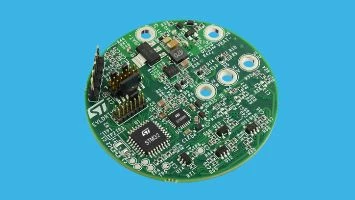
The EVLDRIVE101-HPD (High Power Density) motor-drive reference design packs a 3-phase gate driver, STM32G0 microcontroller, and 750W power stage on a circular PCB just 50mm in diameter. The board features extremely low power consumption in sleep mode, below 1uA, and its tiny outline can fit directly in equipment like hairdryers, handheld vacuums, power tools, and fans. It also fits easily into drones, robots, and drives for industrial equipment such as pumps and process-automation systems.Built with ST’s robust and compact STDRIVE101 3-phase gate driver, the reference design gives flexibility to choose the motor-control strategy, such as trapezoidal or field-oriented control (FOC), with sensored or sensorless rotor-position detection. The STDRIVE101 IC contains three-half bridges with 600 mA source/sink capability and operates from 5.5V to 75V to handle any low-voltage application. The chip integrates voltage regulation for the high-side and low-side gate drivers and configurable drain
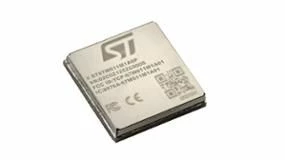
We're excited to announce a new variant of the ST67W611M1 Wi-Fi module, the ST67W611M1A6P. This new module is specifically designed to help developers build more robust and reliable wireless products by overcoming challenging RF environments. The new 'P Version' (ST67W611M1A6P) This new module comes in a compact 32-pin LGA package, making it a great fit for space-constrained designs. Package size: 12.28 x 12.28 x 2.4 mm Package type: 32-pin LGA Pitch: 1.27 mm While the compact form factor is a significant benefit, the standout feature unlocked by this version is receive (RX) diversity. The game-changer: RX diversity We all know that real-world environments are tough on radio signals. The ST67W611M1A6P directly addresses this by using RX diversity to recover radio performance, especially in difficult reception conditions. This feature is essential for tackling common RF problems like: Antenna cross-polarization Multiple reflections on the radio path Multipath fading How it works The
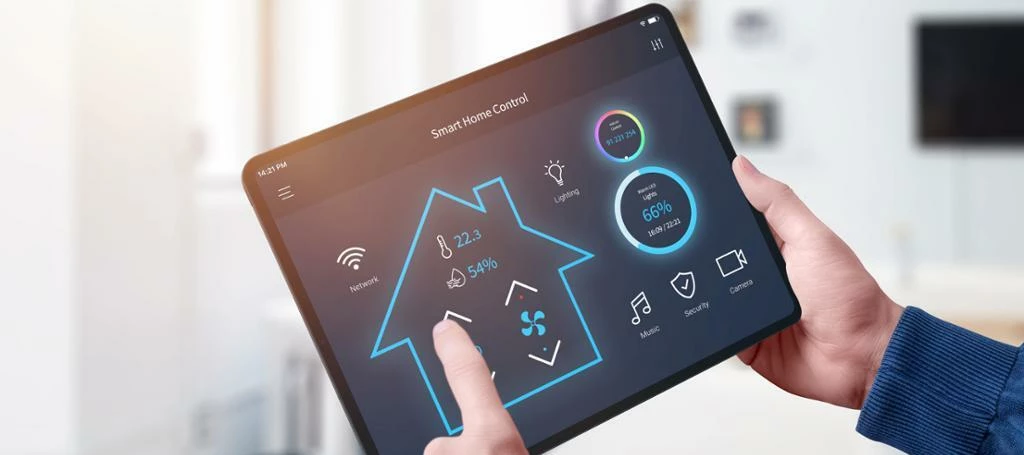
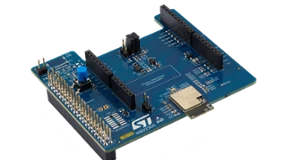
Great news for the smart home and IoT community! The latest X-CUBE-MATTER software expansion now fully supports the ST67W611M1, a high-performance Wi-Fi 6 + Bluetooth® LE 5.4 module designed to simplify your Matter device development. Key benefits for developers: Accelerate Matter device development: leverage the powerful STM32 ecosystem to create secure, high-throughput Wi-Fi Matter products without struggling with complex wireless stacks. Offload wireless connectivity to a dedicated network co-processor: the ST67W611M1 handles all Wi-Fi and Bluetooth® LE operations, freeing your MCU to focus fully on your application logic. Boost performance and security: with network tasks handled separately, your MCU runs more responsively and securely, leveraging Arm® TrustZone® for enhanced protection. Simplify device commissioning: Bluetooth® LE manages device setup, making onboarding easy and secure for users. A powerful and straightforward platform ST offers a complete hardware and soft
To continuously support STM32 developers, STMicroelectronics has rolled out updates across multiple STM32Cube MCU packages. These updates bring important enhancements and fixes aimed at improving your embedded development experience. What’s new? Connectivity & security: Significant upgrades to connectivity stacks and security features help you build more robust and secure applications. Middleware enhancements: Various middleware components have been refined for better performance and reliability. HAL & LL drivers: Numerous bug fixes and optimizations have been applied across hardware abstraction layer (HAL) and low-layer (LL) drivers to improve stability and functionality. Software Bill of Materials (SBOM): Most packages now include an SBOM, offering a standardized inventory of all software components. This addition enhances transparency, making it easier to manage se
Already have an account? Login
Enter your E-mail address. We'll send you an e-mail with instructions to reset your password.