

STM32G431 SPI MCU <--> MCU Communication
I have 2 PCBs, both with STM32G431 MCUs, and both MCUs should communicate with each other via SPI. Both PCBs are assembled in a chassis, the distance between the two PCBs is aprox. 10 cm. For max. Signal integrity I have chosen to use LVDS as a hardware Layer for the board to board connection. I use Texas Instruments SN65LVDS1 and SN65LVDT2 Drivers/Recievers. Some might consider this as complete overkill, but for me it’s worth the effort.
The LVDS itself works pretty well, as shown in the screenshot below: A signal delay of 8 ns from LVDS Driver IC input to LVDS Receiver Output is IMHO more than good enough for a reliable hardware layer, especially at that slow speed.
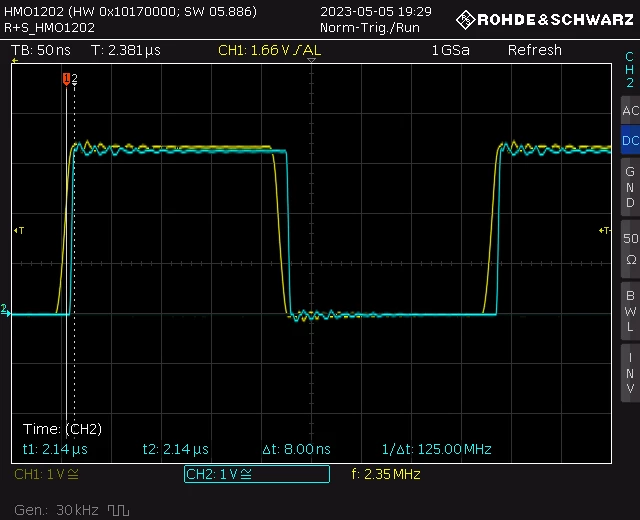
Screenshot. SPI Clock signal Master LVDS Driver Input (yellow), Slave LVDS Receiver Output (blue)
Both MCUs should exchange 20 Byte of data @5 KHz, but until now I could not convince the two STM32s to establish a reliable communication via SPI with each other. The setup for the master and the slave is: 1,2,4 or 8 MHz Clock, CPOL 0, CPHA 1, 8 Byte Motorola, MSB First, no CRC, Slave NSS Hardware Input, Master Software CSn. Both Instances use DMA, the Master in “Normal�? mode, the Slave in “Circular�? Mode. The main issue is: the received array on the Master is shifted by 3 or 4 bytes.
The Slave initiates the SPI communication via UART by sending an “I am ready�? signal to the master, the Master starts the communication with a delay of 25 ms. The Slave inits the SPI before sending the “ready signal�? and waits for incoming transmissions.
Both MCUs use >>HAL_SPI_TransmitReceive_DMA(…)<<, as said before the Master in normal Mode, the Slave in Circular mode. The data on the slave are in sync, but the data received by the master are shifted.
Under normal circumstances I’d say: ok, that’s a speed related issue, let’s slow down the clock. But: it does not matter how fast the SPI Clock is, the issue is the same at 1 Mbit, 2, Mbit or 8 Mbit.
I am pretty sure it’s not a hardware issue. Even at 8 MHz SPI Clock, the delay created by the LVDS ICs (8 ns, or 16 ns from Slave to Master) are negligible, if the SPI shifts the data on the rising edge and samples the data on the falling edge, as the duration of one clock cycle is 125 ns.
As posted here: https://stackoverflow.com/questions/76127056/stm32-g07-full-duplex-spi-master-slave-rx-array-on-master-is-shifted I experienced the same issues with a Test-PCB with a STM32G070, which I created to test that Board to Board connection via LVDS. Which leads me to the conclusion, that this is not a hardware related issue, but must be an Issue of the HAL Drivers …
In difference to the post on stack overflow, the behavior on the STM32G431 is, that if I press the reset button on the Slave, the Communication is in Sync for a few cycles, but then the bytes are shifted pretty soon, where it remains stable.
/rant the HAL SPI DMA implantation is pretty disappointing for me so far. I simply don’t get it, why it’s not possible to sync the slave on the falling NSS signal? SPI works – for me – without issues as Master, but trying to use it as Slave turns out to be a nightmare so far …
My suspicion is, that something with the DMA is going wrong. It’s just a guess, but I’d say the DMA on the Master is “a bit sleepy�? – without being able to provide a proof for that claim, but because the received data on the slave are in sync.
How can I solve this? Any help would be highly appreciated, because this issue is driving me crazy! I have used SPI in several appications as Master e.g. to communicate with Flash Memory, DACs or a WIZnet Ethernet IC and all is working well. But Using an STM32 as SPI Slave seems to be a real issue …
Thanks
