

Frequency limitation when trying to generate a 2us period on a Timerfor the STM32F7.
Hi, I'm trying to generate a 500KHz counter on TIM1 on the STM32F7 to trigger an ADC conversion and I'm currently having issues as it seems to top out at 360KHz. I'm toggling a GPIO pin with a scope to the input and simply changing the Period on the timer to see what's happening.
Here's my current code:
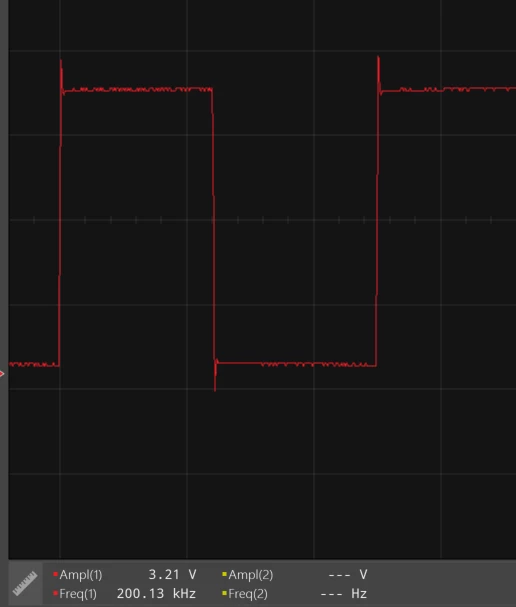
With a period of 539, I get 200Khz as expected:
With a period of 239, I get around 300kHz
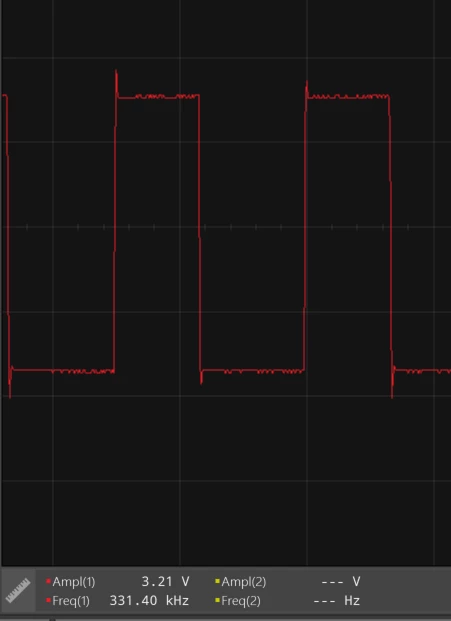
With a peroid of 215, I get around 330 kHz instead of the expected 500Khz.
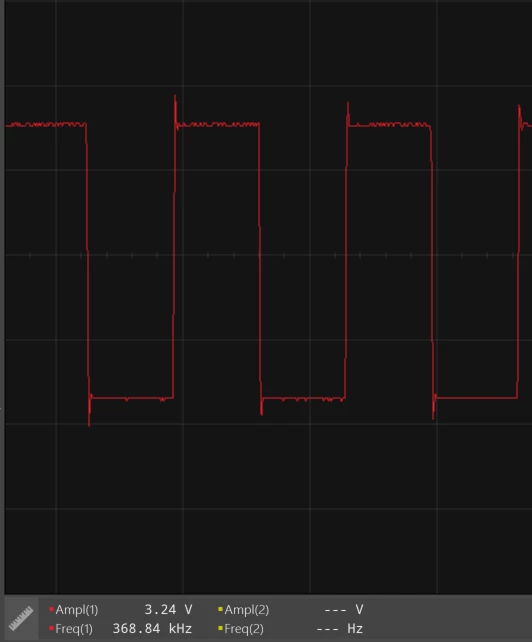
With a period of 108, I get a frequency of around 369Khz:
I'm using CubeMX to generate my project files and I initialise my timer like this:
static void MX_TIM1_Init(void)
{

 /* USER CODE BEGIN TIM1_Init 0 */

 /* USER CODE END TIM1_Init 0 */

 TIM_ClockConfigTypeDef sClockSourceConfig = {0};
 TIM_MasterConfigTypeDef sMasterConfig = {0};

 /* USER CODE BEGIN TIM1_Init 1 */

 /* USER CODE END TIM1_Init 1 */
 htim1.Instance = TIM1;
 htim1.Init.Prescaler = 0;
 htim1.Init.CounterMode = TIM_COUNTERMODE_UP;
 htim1.Init.Period = 108;
 htim1.Init.ClockDivision = TIM_CLOCKDIVISION_DIV1;
 htim1.Init.RepetitionCounter = 0;
 htim1.Init.AutoReloadPreload = TIM_AUTORELOAD_PRELOAD_DISABLE;
 if (HAL_TIM_Base_Init(&htim1) != HAL_OK)
 {
 Error_Handler();
 }
 sClockSourceConfig.ClockSource = TIM_CLOCKSOURCE_INTERNAL;
 if (HAL_TIM_ConfigClockSource(&htim1, &sClockSourceConfig) != HAL_OK)
 {
 Error_Handler();
 }
 sMasterConfig.MasterOutputTrigger = TIM_TRGO_OC1;
 sMasterConfig.MasterOutputTrigger2 = TIM_TRGO2_OC1REF;
 sMasterConfig.MasterSlaveMode = TIM_MASTERSLAVEMODE_DISABLE;
 if (HAL_TIMEx_MasterConfigSynchronization(&htim1, &sMasterConfig) != HAL_OK)
 {
 Error_Handler();
 }
 /* USER CODE BEGIN TIM1_Init 2 */

 /* USER CODE END TIM1_Init 2 */

}
I start the timer in interrupt mode:
if(HAL_TIM_Base_Start_IT(&htim1) != HAL_OK)
		{
			Error_Handler();
		}
I then toggle a GPIO Pin When Period has elapsed:
void HAL_TIM_PeriodElapsedCallback(TIM_HandleTypeDef *htim)
{

	if(htim->Instance == TIM1)
	{

		HAL_GPIO_TogglePin(GPIOG, GPIO_PIN_6);

	}
}
I've tried changing the speed of the GPIO pin:
 /*Configure GPIO pin : PG6 */
 GPIO_InitStruct.Pin = GPIO_PIN_6;
 GPIO_InitStruct.Mode = GPIO_MODE_OUTPUT_PP;
 GPIO_InitStruct.Pull = GPIO_NOPULL;
 GPIO_InitStruct.Speed = GPIO_SPEED_FREQ_VERY_HIGH;
 HAL_GPIO_Init(GPIOG, &GPIO_InitStruct);
but this doesn't seem to make any difference. Can someone please help shed some light on this?
