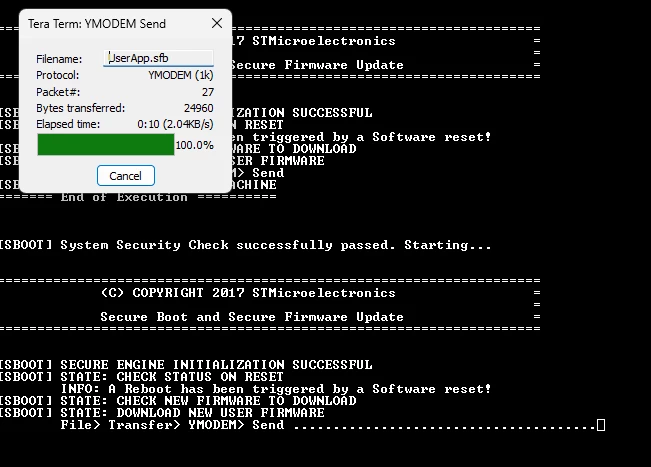
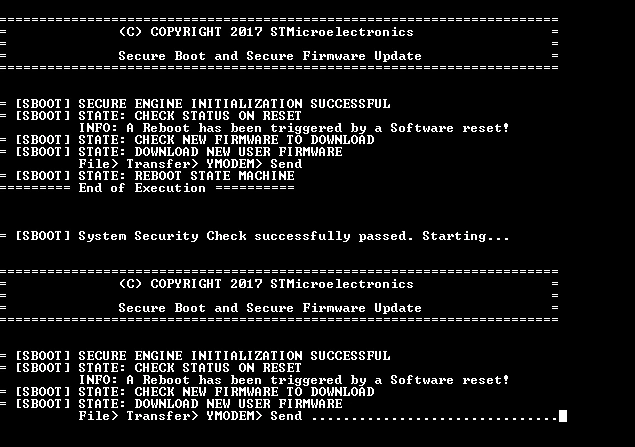
Hello @Vinay_Shirol
Sorry for the late response.
I found the root cause of the issue, and it was not related to the YMODEM timeout.
In my case, the 2-Images_SBSFU project had originally been based on a setup running on NUCLEO-H753, and I ported it to the STM32H753I-EVAL2 board. The issue came from a BSP incompatibility, especially in the user button handling.
I made the following changes for the project to work:
#define SECBOOT_DISABLE_SECURITY_IPS
- updated the clock configuration
- changed the UART from USART3 to USART1, including the UART pins connected to the STLINK
- removed the original NUCLEO BSP
- implemented my own LED and button functions for the target board
The issue originates in the SBSFU FSM
// SBSFU Project, SBSFU/APP/SFU_boot.c
static void SFU_BOOT_SM_CheckNewFwToDownload(void)
{
 SFU_ErrorStatus e_ret_status = SFU_ERROR;
 // ...
 if (initialDeviceStatusCheck == 1U)
 {
 TRACE("\r\n= [SBOOT] STATE: CHECK NEW FIRMWARE TO DOWNLOAD");
 if (0U != BUTTON_PUSHED() // <-- This is the issue
 {
 /* Download requested */
 e_ret_status = SFU_SUCCESS;
 }
 else
 {
 e_ret_status = SFU_ERROR;
 }
 }
 else
 {
 e_ret_status = SFU_SUCCESS;
 }
 SFU_SET_SM_IF_CURR_STATE(e_ret_status, SFU_STATE_DOWNLOAD_NEW_USER_FW, SFU_STATE_VERIFY_USER_FW_STATUS);
}
The issue was that
BUTTON_PUSHED()
was relying on the original BSP button API from the NUCLEO board.
Since this BSP does not match the STM32H753I-EVAL2 hardware, the button state was interpreted incorrectly during boot.
As a result, SBSFU always considered the button as pressed and entered:
SFU_STATE_DOWNLOAD_NEW_USER_FW
instead of continuing the normal boot flow and jumping to the installed user application.
To solve the problem, I removed the old BSP dependency:
#include "stm32h7xx_nucleo_144.h"
and created my own board-specific implementation for:
- LED initialization and control
- button initialization
- button state reading
i have added the board-specific implementation under 2_Images_SBSFU\SBSFU\Target\sfu_low_level.c and 2_Images_SBSFU\SBSFU\Target\sfu_low_level.h .
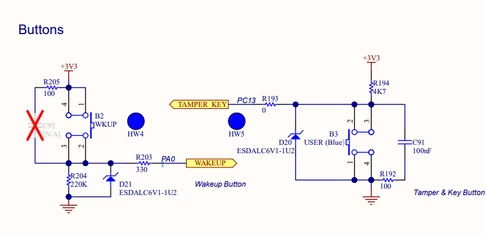
In my case, I used the Wakeup button as the user button (PA0) .
You can find the full project attached below.