

Failed to implement external loader on custom board
# External Loader Issue: STM32U5G9ZJT6Q + MX25L12833FZNI-10G (Quad-SPI)
## 1. Problem Summary
Hello, I'm a novice developer who recently started working with embedded systems. I've been struggling significantly with implementing an external loader for several weeks now...
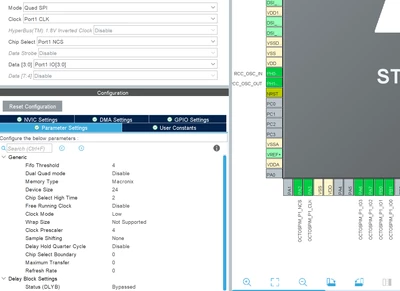
I'm developing an external loader for **MX25L12833F** (16MB Quad-SPI NOR Flash) connected to **STM32U5G9ZJT6Q** via OCTOSPI1, but it continuously fails in STM32CubeProgrammer. The loader compiles successfully and generates a `.stldr` file, but programming operations fail.
The problem is sector erase. Writing, reading, verification, and mass erase all function normally, but only sector erase does not work properly. What could be the reason?
__attribute__((used)) int SectorErase(uint32_t EraseStartAddress, uint32_t EraseEndAddress)
{
 OSPI_RegularCmdTypeDef sCommand;
 uint32_t SectorAddr;
 uint8_t status_before = 0;
 uint8_t status_after = 0;

 g_erase_input_start = EraseStartAddress;
 g_erase_input_end = EraseEndAddress;
 g_erase_call_count++;
 g_erase_loop_count = 0;

 g_last_erase_status = 0;
 g_debug_status1 = 0;
 g_debug_status2 = 0;

 if (EraseStartAddress >= 0x90000000)
 {
 EraseStartAddress -= 0x90000000;
 }
 if (EraseEndAddress >= 0x90000000)
 {
 EraseEndAddress -= 0x90000000;
 }

 EraseStartAddress = EraseStartAddress - (EraseStartAddress % MEMORY_SECTOR_SIZE);

 while (EraseStartAddress < EraseEndAddress)
 {
 g_erase_loop_count++;
 SectorAddr = EraseStartAddress;
 g_erase_actual_addr = SectorAddr;

 OSPI_ReadBytes(SectorAddr, g_data_before_erase, 4);

 /* 1. Write Enable */
 memset(&sCommand, 0, sizeof(OSPI_RegularCmdTypeDef));

 sCommand.OperationType = HAL_OSPI_OPTYPE_COMMON_CFG;
 sCommand.FlashId = HAL_OSPI_FLASH_ID_1;
 sCommand.Instruction = WRITE_ENABLE_CMD;
 sCommand.InstructionMode = HAL_OSPI_INSTRUCTION_1_LINE;
 sCommand.InstructionSize = HAL_OSPI_INSTRUCTION_8_BITS;
 sCommand.InstructionDtrMode = HAL_OSPI_INSTRUCTION_DTR_DISABLE;
 sCommand.AddressMode = HAL_OSPI_ADDRESS_NONE;
 sCommand.AlternateBytesMode = HAL_OSPI_ALTERNATE_BYTES_NONE;
 sCommand.DataMode = HAL_OSPI_DATA_NONE;
 sCommand.DummyCycles = 0;
 sCommand.DQSMode = HAL_OSPI_DQS_DISABLE;
 sCommand.SIOOMode = HAL_OSPI_SIOO_INST_EVERY_CMD;

 if (HAL_OSPI_Command(&hospi1_local, &sCommand, HAL_OSPI_TIMEOUT_DEFAULT_VALUE) != HAL_OK)
 {
 g_last_erase_status = 0x10;
 return 0;
 }

 HAL_Delay(1);

 if (OSPI_ReadStatusReg(&status_before) != HAL_OK)
 {
 g_last_erase_status = 0x11;
 return 0;
 }

 g_debug_status2 = status_before;

 if ((status_before & STATUS_REG_WEL_MASK) == 0)
 {
 g_last_erase_status = 0x12;
 return 0;
 }

 /* 2. 4KB Sector Erase Command (0x20) */
 memset(&sCommand, 0, sizeof(OSPI_RegularCmdTypeDef));

 sCommand.OperationType = HAL_OSPI_OPTYPE_COMMON_CFG;
 sCommand.FlashId = HAL_OSPI_FLASH_ID_1;
 sCommand.Instruction = SECTOR_ERASE_4K_CMD; /* ★ 0x20 ★ */
 sCommand.InstructionMode = HAL_OSPI_INSTRUCTION_1_LINE;
 sCommand.InstructionSize = HAL_OSPI_INSTRUCTION_8_BITS;
 sCommand.InstructionDtrMode = HAL_OSPI_INSTRUCTION_DTR_DISABLE;
 sCommand.Address = SectorAddr;
 sCommand.AddressMode = HAL_OSPI_ADDRESS_1_LINE;
 sCommand.AddressSize = HAL_OSPI_ADDRESS_24_BITS;
 sCommand.AddressDtrMode = HAL_OSPI_ADDRESS_DTR_DISABLE;
 sCommand.AlternateBytesMode = HAL_OSPI_ALTERNATE_BYTES_NONE;
 sCommand.DataMode = HAL_OSPI_DATA_NONE;
 sCommand.DataDtrMode = HAL_OSPI_DATA_DTR_DISABLE;
 sCommand.NbData = 0;
 sCommand.DummyCycles = 0;
 sCommand.DQSMode = HAL_OSPI_DQS_DISABLE;
 sCommand.SIOOMode = HAL_OSPI_SIOO_INST_EVERY_CMD;

 if (HAL_OSPI_Command(&hospi1_local, &sCommand, HAL_OSPI_TIMEOUT_DEFAULT_VALUE) != HAL_OK)
 {
 g_last_erase_status = 0x20;
 return 0;
 }

 HAL_Delay(1);
 OSPI_ReadStatusReg(&g_debug_status1);

 HAL_Delay(10);

 if (OSPI_ManualWaitReady(TIMEOUT_SECTOR_ERASE_4K) != HAL_OK)
 {
 g_last_erase_status = 0x30;
 return 0;
 }

 if (OSPI_ReadStatusReg(&status_after) != HAL_OK)
 {
 g_last_erase_status = 0x40;
 return 0;
 }

 if (status_after & STATUS_REG_WEL_MASK)
 {
 g_last_erase_status = 0x41;
 }

 OSPI_ReadSecurityReg(&g_security_reg);
 if (g_security_reg & SECURITY_REG_E_FAIL_MASK)
 {
 g_last_erase_status = 0x50;
 return 0;
 }

 OSPI_ReadBytes(SectorAddr, g_data_after_erase, 4);

 EraseStartAddress += MEMORY_SECTOR_SIZE;
 }

 return 1;
}

If there is anything else you need besides the attached materials, please let me know.
Any guidance on potential issues or suggestions for debugging would be greatly appreciated!