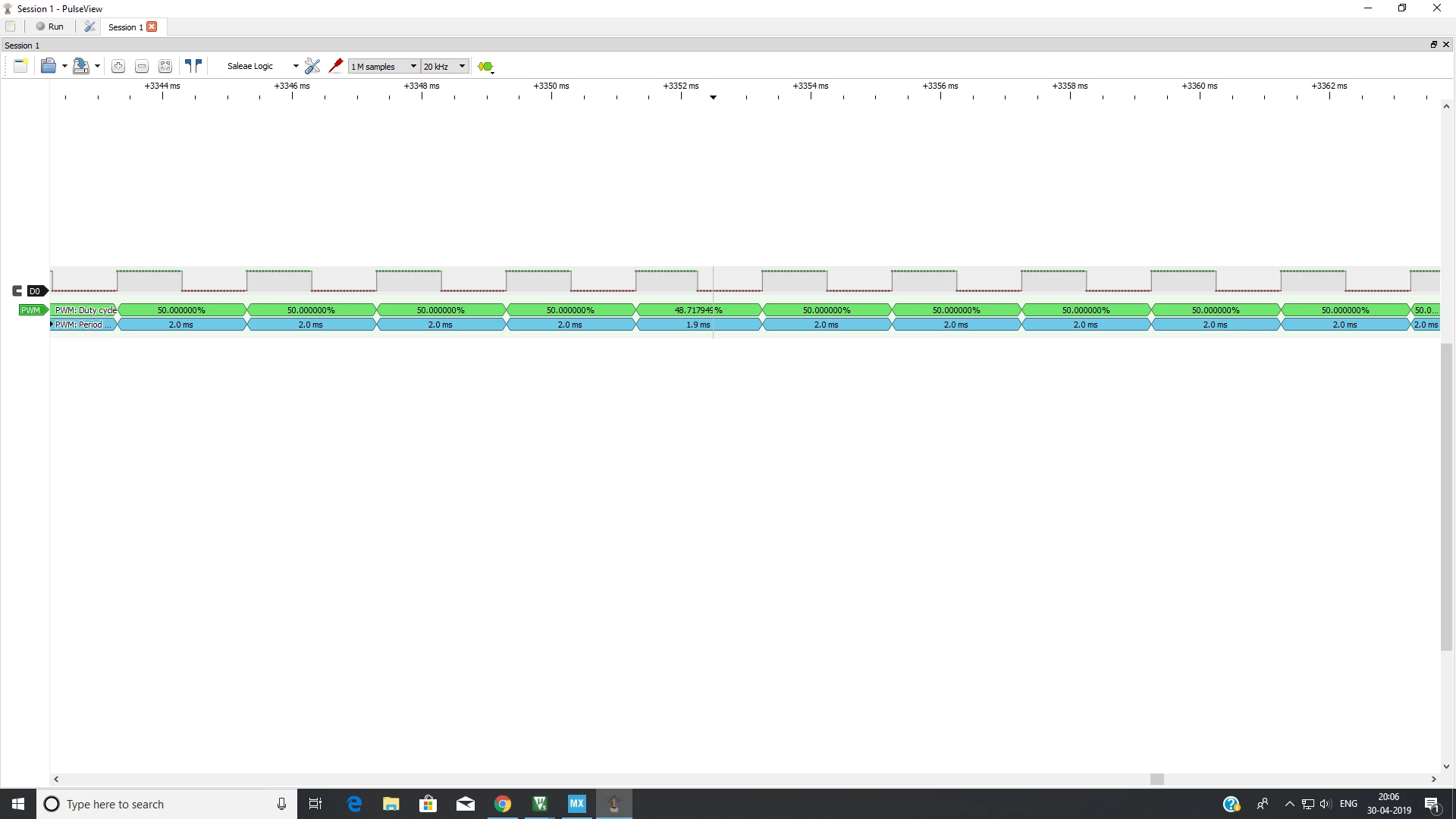
Question
what is the PWM output voltage that is required to rotate the BLDC motor(A2212/10T 1400kv)?
I'm trying to rotate the BLDC using PWM(50% duty cyle, 2ms pwm time period). My timer initialization code:
static void MX_TIM2_Init(void)
{

 /* USER CODE BEGIN TIM2_Init 0 */

 /* USER CODE END TIM2_Init 0 */

 TIM_MasterConfigTypeDef sMasterConfig = {0};
 TIM_OC_InitTypeDef sConfigOC = {0};

 /* USER CODE BEGIN TIM2_Init 1 */

 /* USER CODE END TIM2_Init 1 */
 htim2.Instance = TIM2;
 htim2.Init.Prescaler = 63; //Timer tick frequency is 250KHz
 htim2.Init.CounterMode = TIM_COUNTERMODE_UP;
 htim2.Init.Period =499; //PWM_Frequency is 500Hz
 htim2.Init.ClockDivision = TIM_CLOCKDIVISION_DIV1;
 if (HAL_TIM_PWM_Init(&htim2) != HAL_OK)
 {
 Error_Handler();
 }
 sMasterConfig.MasterOutputTrigger = TIM_TRGO_RESET;
 sMasterConfig.MasterSlaveMode = TIM_MASTERSLAVEMODE_DISABLE;
 if (HAL_TIMEx_MasterConfigSynchronization(&htim2, &sMasterConfig) != HAL_OK)
 {
 Error_Handler();
 }
 sConfigOC.OCMode = TIM_OCMODE_PWM1;
 sConfigOC.Pulse = 249; //Duty cycle - 50%

 sConfigOC.OCPolarity = TIM_OCPOLARITY_HIGH;
 sConfigOC.OCFastMode = TIM_OCFAST_DISABLE;
 if (HAL_TIM_PWM_ConfigChannel(&htim2, &sConfigOC, TIM_CHANNEL_2) != HAL_OK)
 {
 Error_Handler();
 }
 /* USER CODE BEGIN TIM2_Init 2 */

 /* USER CODE END TIM2_Init 2 */
 HAL_TIM_MspPostInit(&htim2);

}
I've checked the pwm output in logic analyzer. The desired duty cycle and time period are coming exactly. But when I measured the pwm voltage it was showing 0.80V. Is it sufficient to rotate the motor?
I've checked the pwm voltage in arduino(same motor, duty cycle and time period). The motor was rotating and the output voltage is 2.6V.
I'm attaching some more code for reference.
void SystemClock_Config(void)
{
 RCC_OscInitTypeDef RCC_OscInitStruct = {0};
 RCC_ClkInitTypeDef RCC_ClkInitStruct = {0};

 /**Configure the main internal regulator output voltage
 */
 __HAL_RCC_PWR_CLK_ENABLE();
 __HAL_PWR_VOLTAGESCALING_CONFIG(PWR_REGULATOR_VOLTAGE_SCALE1);
 /**Initializes the CPU, AHB and APB busses clocks
 */
 RCC_OscInitStruct.OscillatorType = RCC_OSCILLATORTYPE_HSI;
 RCC_OscInitStruct.HSIState = RCC_HSI_ON;
 RCC_OscInitStruct.HSICalibrationValue = RCC_HSICALIBRATION_DEFAULT;
 RCC_OscInitStruct.PLL.PLLState = RCC_PLL_NONE;
 if (HAL_RCC_OscConfig(&RCC_OscInitStruct) != HAL_OK)
 {
 Error_Handler();
 }
 /**Initializes the CPU, AHB and APB busses clocks
 */
 RCC_ClkInitStruct.ClockType = RCC_CLOCKTYPE_HCLK|RCC_CLOCKTYPE_SYSCLK
 |RCC_CLOCKTYPE_PCLK1|RCC_CLOCKTYPE_PCLK2;
 RCC_ClkInitStruct.SYSCLKSource = RCC_SYSCLKSOURCE_HSI;
 RCC_ClkInitStruct.AHBCLKDivider = RCC_SYSCLK_DIV1;
 RCC_ClkInitStruct.APB1CLKDivider = RCC_HCLK_DIV1;
 RCC_ClkInitStruct.APB2CLKDivider = RCC_HCLK_DIV1;

 if (HAL_RCC_ClockConfig(&RCC_ClkInitStruct, FLASH_LATENCY_0) != HAL_OK)
 {
 Error_Handler();
 }
}
int main(void)
{
HAL_Init();
SystemClock_Config();
MX_GPIO_Init();
MX_TIM2_Init();
HAL_TIM_PWM_Start(&htim2,TIM_CHANNEL_2);
while (1)
{
}
}