
Question
Problems with Debug on STM32F4 discovery
Posted on November 09, 2013 at 21:11
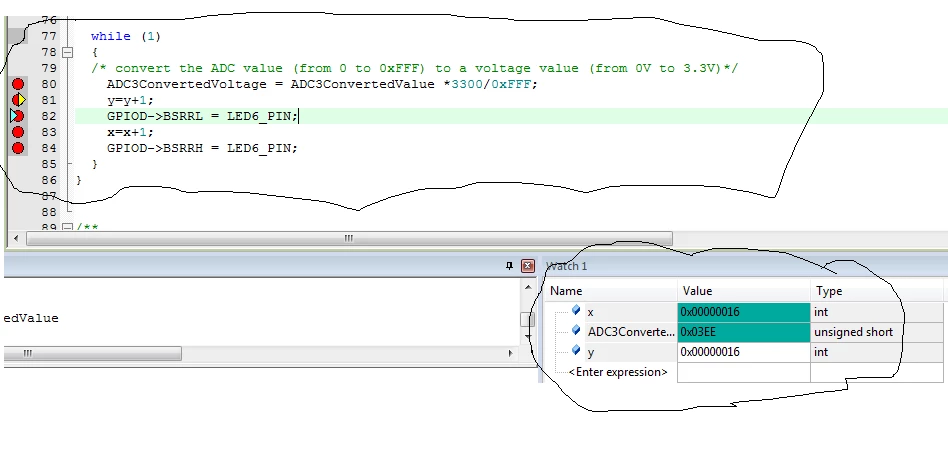 but the program does not stop never on the breakpoint at lines 80, 82 and 84 (ADC3ConvertedVoltage = ADC3ConvertedValue *3300/0xFFF; GPIOD->BSRRL = LED6_PIN; GPIOD->BSRRH = LED6_PIN;) but only at lines 81 and 83 (x=x+1; y=y+1;)
has someone already had a similar problem?and can give me suggestions?
thanks
if shoud to be help I have attached the main
but the program does not stop never on the breakpoint at lines 80, 82 and 84 (ADC3ConvertedVoltage = ADC3ConvertedValue *3300/0xFFF; GPIOD->BSRRL = LED6_PIN; GPIOD->BSRRH = LED6_PIN;) but only at lines 81 and 83 (x=x+1; y=y+1;)
has someone already had a similar problem?and can give me suggestions?
thanks
if shoud to be help I have attached the main
Hi,
I bought a development board STM32F4 discovery. I wanted to try the debug and I modified the example ADC3_DMA in STM32F4-Discovery_FW_V1.1.0 in this mode:
but the program does not stop never on the breakpoint at lines 80, 82 and 84 (ADC3ConvertedVoltage = ADC3ConvertedValue *3300/0xFFF; GPIOD->BSRRL = LED6_PIN; GPIOD->BSRRH = LED6_PIN;) but only at lines 81 and 83 (x=x+1; y=y+1;)
has someone already had a similar problem?and can give me suggestions?
thanks
if shoud to be help I have attached the main
/**
******************************************************************************
* @file ADC3_DMA/main.c
* @author MCD Application Team
* @version V1.0.0
* @date 19-September-2011
* @brief Main program body
******************************************************************************
* @attention
*
* THE PRESENT FIRMWARE WHICH IS FOR GUIDANCE ONLY AIMS AT PROVIDING CUSTOMERS
* WITH CODING INFORMATION REGARDING THEIR PRODUCTS IN ORDER FOR THEM TO SAVE
* TIME. AS A RESULT, STMICROELECTRONICS SHALL NOT BE HELD LIABLE FOR ANY
* DIRECT, INDIRECT OR CONSEQUENTIAL DAMAGES WITH RESPECT TO ANY CLAIMS ARISING
* FROM THE CONTENT OF SUCH FIRMWARE AND/OR THE USE MADE BY CUSTOMERS OF THE
* CODING INFORMATION CONTAINED HEREIN IN CONNECTION WITH THEIR PRODUCTS.
*
* <
h2
><
center
>© COPYRIGHT 2011 STMicroelectronics</
center
></
h2
>
******************************************************************************
*/
/* Includes ------------------------------------------------------------------*/
#include ''stm32f4_discovery.h''
#include <
stdio.h
>
/** @addtogroup STM32F4_Discovery_Peripheral_Examples
* @{
*/
/** @addtogroup ADC_ADC3_DMA
* @{
*/
/* Private typedef -----------------------------------------------------------*/
/* Private define ------------------------------------------------------------*/
#define ADC3_DR_ADDRESS ((uint32_t)0x4001224C)
/* Private macro -------------------------------------------------------------*/
/* Private variables ---------------------------------------------------------*/
/* You can monitor the converted value by adding the variable ''ADC3ConvertedValue''
to the debugger watch window */
__IO uint16_t ADC3ConvertedValue = 0;
__IO uint32_t ADC3ConvertedVoltage = 0;
int x;
int y;
/* Private function prototypes -----------------------------------------------*/
/* Private functions ---------------------------------------------------------*/
void ADC3_CH12_DMA_Config(void);
void InizializzaPorta(void);
/**
* @brief Main program
* @param None
* @retval None
*/
int main(void)
{
/*!<
At
this stage the microcontroller clock setting is already configured,
this is done through SystemInit() function which is called from startup
file (startup_stm32f4xx.s) before to branch to application main.
To reconfigure the default setting of SystemInit() function, refer to
system_stm32f4xx.c file
*/
/* ADC3 configuration *******************************************************/
/* - Enable peripheral clocks */
/* - DMA2_Stream0 channel2 configuration */
/* - Configure ADC Channel12 pin as analog input */
/* - Configure ADC3 Channel12 */
ADC3_CH12_DMA_Config();
/* Start ADC3 Software Conversion */
ADC_SoftwareStartConv(ADC3);
InizializzaPorta();
while (1)
{
/* convert the ADC value (from 0 to 0xFFF) to a voltage value (from 0V to 3.3V)*/
ADC3ConvertedVoltage
=
ADC3ConvertedValue
*3300/0xFFF;
y
=y+1;
GPIOD->BSRRL = LED6_PIN;
x=x+1;
GPIOD->BSRRH = LED6_PIN;
}
}
/**
* @brief ADC3 channel12 with DMA configuration
* @param None
* @retval None
*/
void InizializzaPorta(void)
{
GPIO_InitTypeDef NomePorta;
/* Abilito il segnale di clock della porta */
RCC_AHB1PeriphClockCmd(RCC_AHB1Periph_GPIOD, ENABLE);
/* Enable SYSCFG clock */
RCC_APB2PeriphClockCmd(RCC_APB2Periph_SYSCFG, ENABLE);
/* Configura il pin della porta D numero 15 PD15 al quale é collegato il led */
NomePorta.GPIO_Mode = 0x01; // scrivo 0x01 nel registro MODER il che vuol dire porre il pin in output ---> NomePorta.GPIO_Mode = GPIO_Mode_OUT; vedi manuale STM32F4xxx.PDF
NomePorta.GPIO_OType =0x00; // scrivo 0x00 nel registro OTYPER il che vuol dire porre l'output in push pull (se scrivevamo 0x01 lo poneva in open drain) --->NomePorta.GPIO_OType =GPIO_OType_PP; vedi manuale STM32F4xxx.PDF
NomePorta.GPIO_Pin = ((uint16_t)0x8000);//GPIO_Pin_12; //non sostituisco con esadecimale per semplicità
NomePorta.GPIO_PuPd = 0x01; //Imposto il pin in pull up scrivendo nel registro NomePorta.GPIO_PuPd =GPIO_PuPd_UP
NomePorta.GPIO_Speed = 0x02; //Imposto la velocità del pin ----> NomePorta.GPIO_Speed = GPIO_Speed_50MHz
GPIO_Init(GPIOD, &NomePorta); //Funzione che va a mettere i valori dei campi della struttura NomePorta che abbiamo definito nei registri elencati nei commenti precedenti
}
void ADC3_CH12_DMA_Config(void)
{
ADC_InitTypeDef ADC_InitStructure;
ADC_CommonInitTypeDef ADC_CommonInitStructure;
DMA_InitTypeDef DMA_InitStructure;
GPIO_InitTypeDef GPIO_InitStructure;
/* Enable ADC3, DMA2 and GPIO clocks ****************************************/
RCC_AHB1PeriphClockCmd(RCC_AHB1Periph_DMA2 | RCC_AHB1Periph_GPIOC, ENABLE);
RCC_APB2PeriphClockCmd(RCC_APB2Periph_ADC3, ENABLE);
/* DMA2 Stream0 channel0 configuration **************************************/
DMA_InitStructure.DMA_Channel = DMA_Channel_2;
DMA_InitStructure.DMA_PeripheralBaseAddr = (uint32_t)ADC3_DR_ADDRESS;
DMA_InitStructure.DMA_Memory0BaseAddr = (uint32_t)&ADC3ConvertedValue;
DMA_InitStructure.DMA_DIR = DMA_DIR_PeripheralToMemory;
DMA_InitStructure.DMA_BufferSize = 1;
DMA_InitStructure.DMA_PeripheralInc = DMA_PeripheralInc_Disable;
DMA_InitStructure.DMA_MemoryInc = DMA_MemoryInc_Disable;
DMA_InitStructure.DMA_PeripheralDataSize = DMA_PeripheralDataSize_HalfWord;
DMA_InitStructure.DMA_MemoryDataSize = DMA_MemoryDataSize_HalfWord;
DMA_InitStructure.DMA_Mode = DMA_Mode_Circular;
DMA_InitStructure.DMA_Priority = DMA_Priority_High;
DMA_InitStructure.DMA_FIFOMode = DMA_FIFOMode_Disable;
DMA_InitStructure.DMA_FIFOThreshold = DMA_FIFOThreshold_HalfFull;
DMA_InitStructure.DMA_MemoryBurst = DMA_MemoryBurst_Single;
DMA_InitStructure.DMA_PeripheralBurst = DMA_PeripheralBurst_Single;
DMA_Init(DMA2_Stream0, &DMA_InitStructure);
DMA_Cmd(DMA2_Stream0, ENABLE);
/* Configure ADC3 Channel12 pin as analog input ******************************/
GPIO_InitStructure.GPIO_Pin = GPIO_Pin_2;
GPIO_InitStructure.GPIO_Mode = GPIO_Mode_AN;
GPIO_InitStructure.GPIO_PuPd = GPIO_PuPd_NOPULL ;
GPIO_Init(GPIOC, &GPIO_InitStructure);
/* ADC Common Init **********************************************************/
ADC_CommonInitStructure.ADC_Mode = ADC_Mode_Independent;
ADC_CommonInitStructure.ADC_Prescaler = ADC_Prescaler_Div2;
ADC_CommonInitStructure.ADC_DMAAccessMode = ADC_DMAAccessMode_Disabled;
ADC_CommonInitStructure.ADC_TwoSamplingDelay = ADC_TwoSamplingDelay_5Cycles;
ADC_CommonInit(&ADC_CommonInitStructure);
/* ADC3 Init ****************************************************************/
ADC_InitStructure.ADC_Resolution = ADC_Resolution_12b;
ADC_InitStructure.ADC_ScanConvMode = DISABLE;
ADC_InitStructure.ADC_ContinuousConvMode = ENABLE;
ADC_InitStructure.ADC_ExternalTrigConvEdge = ADC_ExternalTrigConvEdge_None;
ADC_InitStructure.ADC_DataAlign = ADC_DataAlign_Right;
ADC_InitStructure.ADC_NbrOfConversion = 1;
ADC_Init(ADC3, &ADC_InitStructure);
/* ADC3 regular channel12 configuration *************************************/
ADC_RegularChannelConfig(ADC3, ADC_Channel_12, 1, ADC_SampleTime_3Cycles);
/* Enable DMA request after last transfer (Single-ADC mode) */
ADC_DMARequestAfterLastTransferCmd(ADC3, ENABLE);
/* Enable ADC3 DMA */
ADC_DMACmd(ADC3, ENABLE);
/* Enable ADC3 */
ADC_Cmd(ADC3, ENABLE);
}
#ifdef USE_FULL_ASSERT
/**
* @brief Reports the name of the source file and the source line number
* where the assert_param error has occurred.
* @param file: pointer to the source file name
* @param line: assert_param error line source number
* @retval None
*/
void assert_failed(uint8_t* file, uint32_t line)
{
/* User can add his own implementation to report the file name and line number,
ex: printf(''Wrong parameters value: file %s on line %d\r\n'', file, line) */
/* Infinite loop */
while (1)
{
}
}
#endif
/**
* @}
*/
/**
* @}
*/
/******************* (C) COPYRIGHT 2011 STMicroelectronics *****END OF FILE****/