bryan costanich
Associate II
November 11, 2017
Question

Determining the ADC frequency and # of Sampling Periods

  • November 11, 2017
  • 7 replies
  • 5029 views
Posted on November 11, 2017 at 04:06

Hi folks!

I'm working with a Netduino, which has an STM32F4, running at 168MHz.

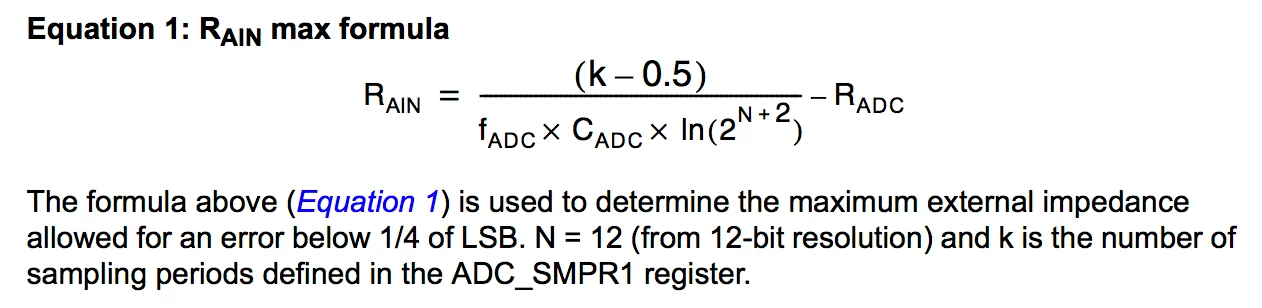
I'm trying to doa calculation (specifically the following), which needs the ADC frequency (

Fadc

) and number of sampling periods (

k

:(

0690X0000060PD9QAM.png

I'm having a little trouble tracking these down, however.

Tackling

Fadc

first,

https://github.com/WildernessLabs/Netduino_SDK/blob/master/Netduino_3_NETMF/DeviceCode/Targets/Native/Netduino_STM32/DeviceCode/STM32_Analog/STM32_AD_functions.cpp#L35

https://github.com/WildernessLabs/Netduino_SDK/blob/master/Netduino_3_NETMF/DeviceCode/Targets/Native/Netduino_STM32/DeviceCode/STM32_Analog/STM32_AD_functions.cpp#L35

, which is peripheral clock / 2 (according to the note next toit). I’m pretty sure from my reading that the peripheral clock is the same as the MCU clock, and my MCU is set to 168MHz. So 168MHz / 2 = 84MHz. However, the data sheet says that the ADC Clock Frequency (fADC) is between 30 and 36MHz for VDDA of 2.5V to 3.6V, and the VDDA on the Netduino should be around 3.3V. So what is the actual value here?

For the number of sampling periods, Ifound the following in source:

#

define

STM32_AD_SAMPLE_TIME

2

//

sample time = 28 cycles

ADC1->SMPR1 =

0x00249249

*

STM32_AD_SAMPLE_TIME

;

So SMPR1 has a hex value of 0x00249249 which is2,396,745 in base 10, so I get 4,793,490 for the number sampling periods, but that can't be right either, considering when I was looking at a sample for the STM32F1, it had a sampling time of 8:

0690X0000060PDVQA2.png

With my answer 6 orders of magnitude off, I think it's probably not right. So I'd appreciate the help.

    This topic has been closed for replies.

    7 replies

    raptorhal2
    Lead
    November 11, 2017
    Posted on November 11, 2017 at 21:16

    It's me again.

    The ADC group has a programmable prescalar which you set to change the input clock to a value the ADCs can handle. See the ADCPRE field in the Reference Manual ADC_CCR register description.

    The sample time register you are reading contains sample time bit fields for 9 or 10 channels. See the Reference Manual definition for the ADC_SMPR1 and ADC_SMPR2 registers.

    Hal

    bryan costanich
    Associate II
    November 13, 2017
    Posted on November 13, 2017 at 18:05

    Ok, that gets me a little further:

    0x00249249 * 2 = 0x492492 = b010010010010010010010010

    So each of those ADC channels are being set to

    010

    , or 28 cycles. So if I'm understanding correctly what

    k

    is, then:

    k = 28

    But I'm still stuck on

    Fadc,

     i

    t's set to default (

    0

    ) in the firmware source, which

    is peripheral clock / 2 (according to the note next to it). I’m pretty sure from my reading that the peripheral clock is the same as the MCU clock, and my MCU is set to 168MHz. So 168MHz / 2 = 84MHz. However, the data sheet says that the ADC Clock Frequency (fADC) is between 30 and 36MHz for VDDA of 2.5V to 3.6V, and the VDDA on the Netduino should be around 3.3V. So what is the actual value here?

    bryan costanich
    Associate II
    November 13, 2017
    Posted on November 13, 2017 at 18:17

    ohhh.. that's what you meant by the 

    ADCPRE.

    00: PCLK2 divided by 2

    01: PCLK2 divided by 4

    10: PCLK2 divided by 6

    11: PCLK2 divided by 8

    I just need to go find that.

    bryan costanich
    Associate II
    November 13, 2017
    Posted on November 13, 2017 at 18:31

    So I'm back to the beginning on that because:

    ADC->CCR =

    0

    ;

    Which means those bits are 00, or PCLK/2, which is 84MHz.  

    What am I missing here?

    waclawek.jan
    Super User
    November 13, 2017
    Posted on November 13, 2017 at 19:22

    Maybe not you but the original author of that code?

    JW

    raptorhal2
    Lead
    November 13, 2017
    Posted on November 13, 2017 at 22:36

    You seem to be missing that these registers are programmable by you, you don't have to accept the reset values. This programming is done in your software prior to enabling and starting the ADC.

    Hal

    raptorhal2
    Lead
    November 13, 2017
    Posted on November 13, 2017 at 23:30

    Correction - do you have access to the code to determine what the ADCPRE field is set to prior to enabling and starting the ADC ?

    Hal

    bryan costanich
    Associate II
    November 14, 2017
    raptorhal2
    Lead
    November 14, 2017
    Posted on November 14, 2017 at 16:37

    The max allowable ADC frequency as a function of Vdda is as you noted, but the ADC can run slower. For your case, ADCPRE should be set to at least 2 (divide by 6, Fadc = 28 MHz), unless of course there is some other not visible to us clock configuration code or hardware that initializes PCLK to less than 168 MHz.

    The sampling time can also be changed by changing the ADC_SMPR1 SMP10 field to as much as 7 to get a sampling time of as much as 480 cycles. Only Channel 10 is being converted, so ADC_SMPR2 and the other fields of ADC_SMPR1 do not need to be changed unless you decide to convert other channels.

    I believe you have all the information now to do your resistance calculation.

    Hal

    bryan costanich
    Associate II
    November 14, 2017
    Posted on November 14, 2017 at 17:40

    There must be some other place where it's being set, though we can't seem to find it. 

    I'll keep digging. Until I know

    Fadc

    , I can't do the resistance calc.

    :(